Crypto Investment Scams: Wrong-Number Texts to Fake Trading Apps
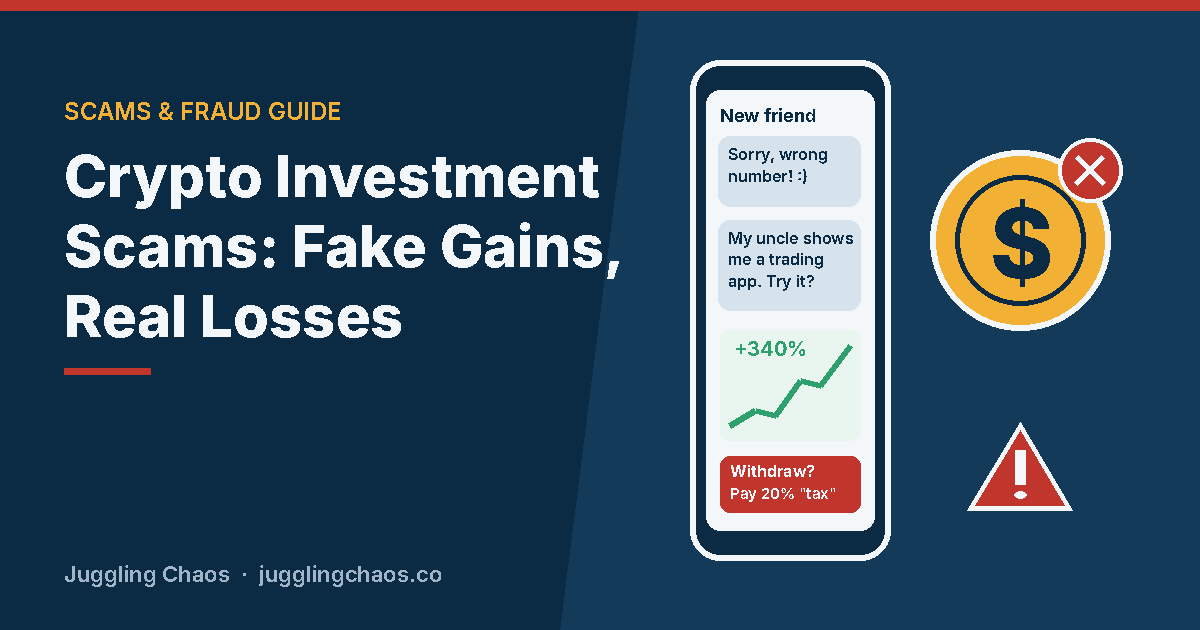
A cryptocurrency investment scam usually starts with a friendly stranger, not a sales pitch. It might be a text that seems to reach the wrong number, a message on social media, or a match on a dating app. Over weeks of chatting, the new friend mentions how well they are doing with crypto and offers to show you how. They send you to a trading website or app that shows your money growing. The gains aren’t real, the money is gone, and the people behind it often come back later pretending to help you recover it.
This guide is for anyone who gets unexpected messages from strangers, and for the family members who help them sort out what is real. It is not investment advice. The advice below was checked against the Federal Trade Commission (FTC), the Securities and Exchange Commission (SEC), the Commodity Futures Trading Commission (CFTC) and the FBI’s Internet Crime Complaint Center (IC3) on October 24, 2026.
How these scams unfold
The CFTC describes this kind of fraud as “a long story, not a single act.” It tends to follow the same path:
- The first message. A text like “Hi, is this Linda? Are we still on for coffee?” or a friendly note on social media. The FTC says scammers use these as conversation starters. If you reply, they apologize and keep chatting.
- The friendship. The SEC calls it a “long con.” The person builds trust over weeks or months through friendship, romance, or an offer to help you reach money goals. They often ask to move the chat to another app, and plans to meet in person never happen.
- The coaching. Eventually they mention an investment, often crypto, that has done well for them or a relative. They offer to walk you through it.
- The fake platform. They send you to a website or app that looks like a real trading platform. The SEC warns that fake screenshots or rigged accounts can make losses look like gains, and that an app being listed in a well-known app store doesn’t mean it is legitimate.
- The withdrawal wall. After you deposit more, sometimes from retirement savings, trying to cash out brings delays and new “taxes” or “fees” to pay first.
- The recovery pitch. Later, someone claiming to be a regulator, law firm or recovery service offers to get your money back for an upfront fee. The CFTC says it may be the same group that ran the original scam.
Warning signs
- A stranger brings up investing. The FTC says unexpected messages on social media about investment opportunities almost always lead to scams.
- Online friendship and money advice mix. The FTC’s rule is simple: never mix online dating and investment advice. The same goes for a friendly wrong-number contact.
- Guaranteed or easy profits. The FTC says only scammers guarantee profits or big returns. All investments carry risk.
- You are asked to pay in crypto. According to the FTC, only scammers demand payment in cryptocurrency.
- You must pay to withdraw your own money. The SEC advises never making an upfront payment to release funds.
- They want it kept secret. Scammers often ask you not to tell family or your bank, or coach you on what to say.
- Someone offers to recover lost crypto for a fee. The FTC says nobody legitimate will contact you out of the blue with this kind of offer.
How to protect yourself
- Don’t reply to wrong-number texts. The FTC notes that even a short reply confirms your number works. Use your phone’s “report junk” option or forward the text to 7726 (SPAM), then delete it.
- Ignore and block unexpected investment contacts. The SEC advises making your own investment decisions rather than following advice from people you met online.
- Check anyone who offers investment help. The SEC’s Check Out Your Investment Professional tool on Investor.gov shows whether a person or firm is registered and whether they have a disciplinary history.
- Never send crypto to someone you have only known online. That is the CFTC’s advice, and it applies no matter how long you have been talking.
- Don’t invest in something you don’t fully understand. If you can’t explain how the platform makes money, step back.
- Talk to someone you trust first. A family member or your bank can be a useful second set of eyes.
Crypto ATMs: a common way the money leaves
Crypto ATMs (often called Bitcoin ATMs) look like regular cash machines, but they turn cash into cryptocurrency and send it to a digital wallet. The FTC says scammers sometimes stay on the phone while walking people step by step to one of these machines, then have them scan a QR code that sends the money to the scammer’s wallet.
This also happens in imposter scams, where a caller claims your bank account has a problem. The FTC says:
- Anyone who tells you to use a Bitcoin ATM to protect your money or fix a problem is a scammer.
- There is no such thing as a government Bitcoin account or digital wallet.
- Never withdraw cash in response to an unexpected call or message.
- If you’re worried about your account, call your bank using the number on your statement or card, not the number the caller gave you.
- A caller who gives you a QR code to deposit cash is a scammer.
Why the “withdrawal fee” never ends
The point where you try to cash out is often where people realize something is wrong, and it is also where scammers try to collect more. You may be told you owe taxes on your gains or a verification fee, which looks small next to the balance on screen.
The SEC says scammers invent these delays and fees to get more money. A fee to release your funds is a sign the platform is fake. Stop paying, stop logging in to the platform, and stop communicating with the people involved.
If it already happened
Many smart, careful people have lost money this way. The CFTC notes these scams target people of all ages. Act quickly and work through what applies:
- You only exchanged messages: stop replying, block the number or profile, and report it. Don’t send money or personal information.
- You sent cryptocurrency or used a crypto ATM: the FTC advises contacting the exchange or ATM operator right away, telling them it was a fraudulent transaction, and asking them to reverse it. Crypto payments usually can’t be undone, but the sooner you ask, the better.
- You sent money from a bank account or card: call your bank or card company now using the number on your card or statement and tell them it was fraud.
- You are being asked to pay a fee or tax to withdraw: don’t pay. Stop communicating and report it.
- You gave personal or account information: visit IdentityTheft.gov for a recovery plan, change passwords, and consider a credit freeze.
- Someone offers to recover your money for a fee: it’s a recovery scam. The FTC warns that if you pay any fee or give account details, that money will be gone too. IC3 says it does not work with any non-law-enforcement group, such as crypto recovery services or law firms, to recover funds, and it will never contact you directly asking for money.
Report what happened even if you didn’t lose money. File with the FBI at IC3.gov, the FTC at ReportFraud.ftc.gov, the SEC at sec.gov/tcr, or the CFTC at cftc.gov/complaint. IC3 asks for wallet addresses, the amount and type of crypto, transaction IDs (sometimes called hashes), dates and times, how you met the person, and any websites, apps and phone numbers involved. People 60 and older can call the National Elder Fraud Hotline at 833-372-8311 for help filing.
Helping an older parent with crypto and investment scams
- Talk about these scams regularly and casually. The CFTC says open talk about fraud reduces stigma and makes people more likely to report.
- Listen for two signs the CFTC points to: a new online relationship, and talk of investing in crypto for the first time.
- Agree on a family rule: “If anyone tells us to go to a crypto ATM, withdraw cash, or pay a fee to get money back, we hang up and call each other.”
- If they have lost money, lead with kindness, not blame. Help them gather records and file reports, and warn them that recovery offers will likely follow.
Checklist
- Wrong-number and “hi, how are you?” texts get reported to 7726 and deleted, not answered.
- Nobody takes investment advice from someone they met online.
- Anyone offering investment help gets checked on Investor.gov.
- Everyone knows a crypto ATM request means a scam.
- IC3.gov and ReportFraud.ftc.gov are saved, and no one pays for “recovery” help.
FAQ
Is all cryptocurrency a scam?
No. This guide doesn’t weigh in on crypto as an investment. The warning signs are about how it is used: a stranger steering you to a platform, guaranteed returns, or a demand for payment in crypto. The FTC notes that crypto isn’t government insured and doesn’t have the dispute protections that credit and debit cards have.
The app is in a major app store. Doesn’t that mean it’s real?
Not necessarily. The SEC warns that an app being available in a well-known app store doesn’t mean the app, or what happens inside it, is legitimate.
Can I get my money back?
Sometimes, but it is often hard. Crypto payments usually can’t be reversed, so recovery depends largely on how quickly you contact the exchange or ATM operator and law enforcement. The FTC also notes that some states have laws that might help. Be very wary of anyone who promises results for an upfront fee.
What if the person I’ve been talking to seems genuinely kind?
That is how these scams work. The SEC explains that scammers spend weeks or months building trust before money ever comes up. If a new friend brings up investing, step back and talk to someone you know in person.
Related guides
- Scam Texts: How to Spot a Fake Text Message
- Refund, Settlement, and Recovery Scams
- How Scammers Tell You to Pay (FTC Video Guide)
Sources
- Federal Trade Commission, “What To Know About Cryptocurrency and Scams,” consumer.ftc.gov, accessed October 24, 2026.
- Federal Trade Commission, “Why it’s not rude to ignore ‘hi, how are you?’ text messages from strangers,” consumer.ftc.gov, accessed October 24, 2026.
- Federal Trade Commission, “Unexpected messages on social media about investing are almost always scams,” consumer.ftc.gov, accessed October 24, 2026.
- Federal Trade Commission, “Scammers use Bitcoin ATMs to steal your money,” consumer.ftc.gov, accessed October 24, 2026.
- Federal Trade Commission, “Did someone send you to a Bitcoin ATM? It’s a scam,” consumer.ftc.gov, accessed October 24, 2026.
- Federal Trade Commission, “What To Do if You Were Scammed,” consumer.ftc.gov, accessed October 24, 2026.
- Federal Trade Commission, “Worried about crypto exchange losses? Don’t pay money for ‘help’ recovering money,” consumer.ftc.gov, accessed October 24, 2026.
- U.S. Securities and Exchange Commission, “Relationship Investment Scams,” investor.gov, accessed October 24, 2026.
- U.S. Securities and Exchange Commission, “Check Out Your Investment Professional,” investor.gov, accessed October 24, 2026.
- Commodity Futures Trading Commission, “Relationship Cons, Recovery Scams, & Money Laundering,” cftc.gov, accessed October 24, 2026.
- Commodity Futures Trading Commission, “Help Warn Others About Relationship Investment Scams,” cftc.gov, accessed October 24, 2026.
- Federal Bureau of Investigation, Internet Crime Complaint Center, “Cryptocurrency,” ic3.gov, accessed October 24, 2026.
This is general information, not legal or financial advice. If you lost money, contact your bank or payment provider right away and report the scam at ReportFraud.ftc.gov.
Get one safety checklist a month
Juggling Chaos Monthly is free: one 15-minute checklist, one scam warning sign, and our newest guides. Sign up on the newsletter page.
Juggling Chaos will never ask for a password, payment, gift card, or verification code. Guides are general information, not legal or financial advice; see our Disclaimer and Terms and Editorial Policy.