Health Insurance and Medicare Enrollment Scams: How to Pick a Plan Safely
Every fall, millions of people pick or change a health plan, and scammers follow the crowd. They build websites that look like HealthCare.gov or Medicare.gov, buy search ads that appear above the real sites, and call people offering “free” benefits or a new Medicare card. Some sell plans that turn out not to be health insurance at all. Others just want your Medicare number or Social Security number.
This guide explains when enrollment happens, the scams to watch for, and how to shop for a plan safely. It is for anyone choosing coverage, and for the adult children who help a parent with Medicare. The dates and advice below were checked against the FTC, HealthCare.gov and Medicare.gov on October 12, 2026.
When open enrollment happens
- Medicare Open Enrollment: October 15 to December 7 each year. This is when people with Medicare can join, switch or drop a Medicare Advantage or drug plan.
- Medicare Advantage Open Enrollment: January 1 to March 31, only for people already in a Medicare Advantage plan.
- Marketplace (Affordable Care Act) plans on HealthCare.gov: Open Enrollment starts November 1. Enroll by December 15 for coverage that starts January 1. The last day to enroll or change plans is January 15.
Some states run their own marketplace with different deadlines. HealthCare.gov will point you to your state’s site if so.
Health insurance scams to watch for
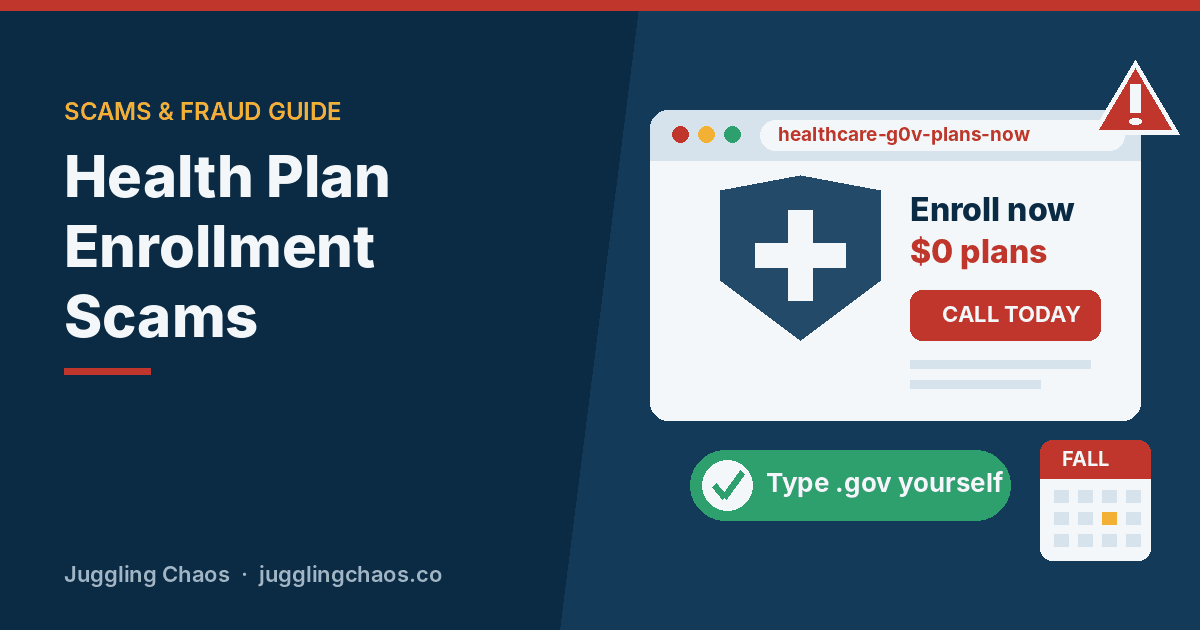
- Lookalike websites. The FTC warns that scammers use web addresses that resemble government sites, along with official-looking logos, so their pages look like HealthCare.gov or Medicare.gov.
- Sponsored search results. Scammers and dishonest businesses can pay to appear at the top of search results. Calling the number in the ad can lead to a high-pressure sales call.
- Plans that aren’t insurance. A “discount plan” or other product sold as health coverage that won’t actually pay for much care when you need it.
- Fake Medicare calls. A caller says you need a new Medicare card, are owed a refund, or qualify for extra benefits, and asks you to “confirm” your Medicare or Social Security number.
- “Free” medical equipment or tests. An offer of a free brace, genetic test or supplies in exchange for your Medicare number. The goal is to bill Medicare in your name.
- Fees to enroll. Someone charges you to sign up or “lock in” a rate. Help from HealthCare.gov, Medicare and official counselors is free.
Warning signs
- The website doesn’t end in .gov but claims to be the official marketplace or Medicare.
- Someone calls you out of the blue to sell a plan or ask for your Medicare number. Medicare.gov says Medicare will never call you to sell you anything.
- There’s pressure to decide today, or a claim that the offer or price disappears after this call.
- They ask for a fee to enroll, to get a new card, or to keep your benefits.
- They won’t give you written details of what the plan covers, or they avoid the words “health insurance.”
How to shop for a plan safely
For a step-by-step walkthrough of reviewing and comparing plans, see our Open Enrollment Guide.
- Type the official address yourself. Use HealthCare.gov for Marketplace plans and Medicare.gov for Medicare. Don’t click an ad to get there.
- Scroll past “Ad” or “Sponsored” results in search. The FTC recommends this simple step.
- Check that the address ends in .gov before you enter any personal information.
- Call the official numbers if you’d rather talk to someone: Medicare at 1-800-633-4227 (1-800-MEDICARE), or the Marketplace Call Center at 1-800-318-2596.
- Get free, unbiased local help. Your State Health Insurance Assistance Program (SHIP) offers free Medicare counseling at shiphelp.org. For Marketplace plans, use “Find Local Help” on HealthCare.gov.
- Get plan details in writing and compare them on the official site before you agree to anything.
Protect your Medicare number
Treat your Medicare card like a credit card. Share the number only with your doctors, pharmacy, your insurer, or people you trust who work with Medicare on your behalf. Read your Medicare Summary Notices or plan statements and look for services or equipment you never received.
If you think you were scammed
- You gave your Medicare number: call 1-800-MEDICARE (1-800-633-4227) and explain what happened, then check your statements for charges you don’t recognize.
- You gave your Social Security number: go to IdentityTheft.gov for a recovery plan and consider a credit freeze.
- You paid by card: call your card company, report the fraud and ask to dispute the charge.
- You signed up for a plan you didn’t want: contact HealthCare.gov or Medicare through the official numbers to review your options.
- You have a Medicare Advantage or drug plan: you can also report fraud to the Investigations Medicare Drug Integrity Contractor at 1-877-7SAFERX (1-877-772-3379).
- You want help or advice on Medicare fraud: your local Senior Medicare Patrol can help at smpresource.org.
Report the scam to the FTC at ReportFraud.ftc.gov and to your state attorney general.
Helping an older parent with Medicare enrollment
- Sit down together during Open Enrollment and compare plans on Medicare.gov, or book a free SHIP counseling appointment.
- Agree on a rule: “We never give the Medicare number to someone who called us. We call Medicare back.”
- Write the official numbers on a card by the phone: 1-800-MEDICARE and their SHIP office.
- Offer to review any letter, card or “free” offer before they reply.
Checklist
- Enrollment dates are on the calendar: Medicare October 15 to December 7, Marketplace November 1 to January 15.
- We go to HealthCare.gov or Medicare.gov by typing the address, not through ads.
- Nobody shares a Medicare or Social Security number with a caller.
- Plan details are in writing before anyone signs up.
- The SHIP office number and 1-800-MEDICARE are saved.
FAQ
Do I have to pay to get a new Medicare card?
No. Medicare cards are free, so anyone who asks you to pay for a new or replacement card is running a scam. Hang up and call 1-800-MEDICARE if you’re unsure.
Is a site that says “Obamacare” or “ACA” the real marketplace?
Not always. Many private sites use those words. Some are licensed brokers, some are not. The official federal marketplace is HealthCare.gov, or your state’s own marketplace, which HealthCare.gov will point you to.
A licensed agent called me. Is that allowed?
Be careful with any call you didn’t ask for. If you want help, choose an agent yourself or use free SHIP or Marketplace counselors. Don’t share your Medicare or Social Security number on a call you didn’t start.
What does “not health insurance” mean?
Some products, like medical discount plans, are sold alongside insurance but don’t pay for your care the way a health plan does. Before you buy, ask in writing what the plan pays for and compare it with plans on the official site.
Related guides
- Open Enrollment Guide: How to Review and Choose a Medicare or Marketplace Plan
- Medicare Scams: A Widow’s Story (FTC Video Guide)
- Imposter Scams: How to Spot Someone Pretending to Be an Agency or a Company You Trust
- Stop Scam Calls on a Parent’s Phone
Sources
- Federal Trade Commission, “What to know ahead of Open Enrollment to avoid health insurance scams,” consumer.ftc.gov, accessed October 12, 2026.
- HealthCare.gov, “Dates and deadlines,” healthcare.gov, accessed October 12, 2026.
- Medicare.gov, “Reporting Medicare fraud and abuse,” medicare.gov, accessed October 12, 2026.
- Medicare.gov, “Joining a plan,” medicare.gov, accessed October 12, 2026.
This is general information, not legal or financial advice. If you lost money, contact your bank or payment provider right away and report the scam at ReportFraud.ftc.gov.
Get one safety checklist a month
Juggling Chaos Monthly is free: one 15-minute checklist, one scam warning sign, and our newest guides. Sign up on the newsletter page.
Juggling Chaos will never ask for a password, payment, gift card, or verification code. Guides are general information, not legal or financial advice; see our Disclaimer and Terms and Editorial Policy.