Open Enrollment Guide: How to Review and Choose a Medicare or Marketplace Plan
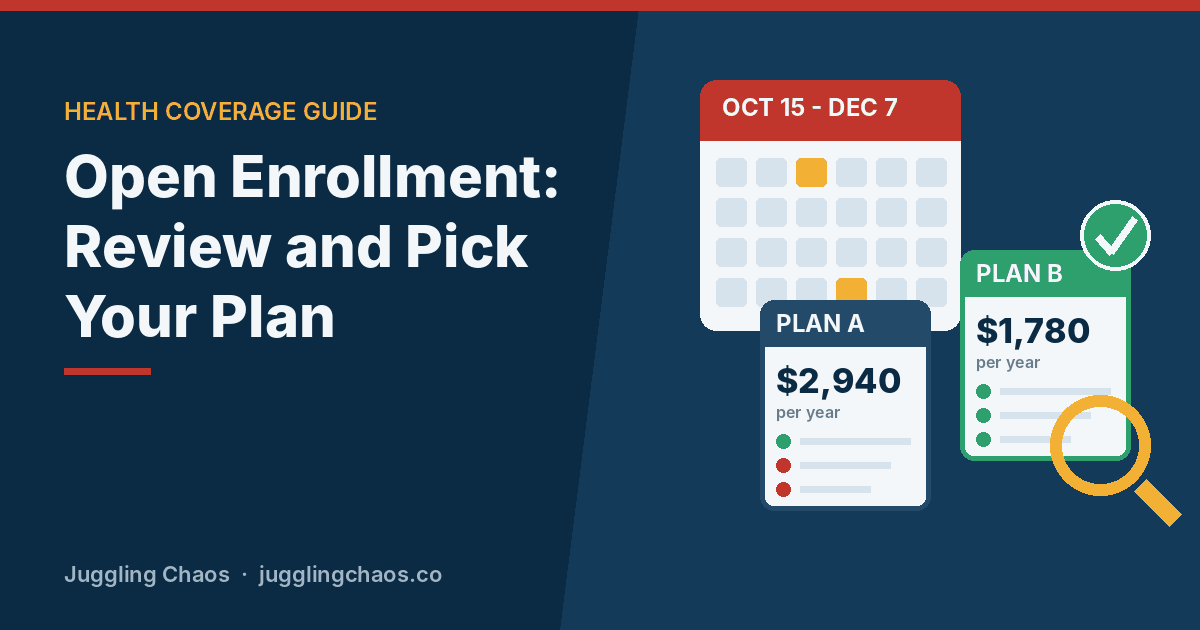
Open enrollment is the one stretch each year when you can freely change your health coverage. For people with Medicare it runs October 15 to December 7. For Affordable Care Act plans on HealthCare.gov it runs November 1 to January 15. Plans change their prices, drug lists and doctor networks every year, so the plan that worked last year may cost more or cover less next year, even if you do nothing.
This guide walks through how to review your current plan and compare others, step by step, for both Medicare and Marketplace coverage. It is written for anyone choosing a plan, and for family members helping a parent. The dates and steps below were checked against Medicare.gov and HealthCare.gov on October 12, 2026. For the scams that circle this season, see our companion guide, Health Insurance and Medicare Enrollment Scams.
Key dates at a glance
- By September 30: Medicare Advantage and Part D drug plans send members an Annual Notice of Change listing next year’s changes.
- October 15 to December 7: Medicare Open Enrollment. Changes start January 1.
- November 1: Marketplace Open Enrollment opens on HealthCare.gov.
- December 15: last day to pick a Marketplace plan for coverage that starts January 1.
- January 15: Marketplace Open Enrollment ends in states that use HealthCare.gov. States with their own marketplace may set different dates.
- January 1 to March 31: Medicare Advantage Open Enrollment, only for people already in a Medicare Advantage plan.
Part 1: Medicare open enrollment
What you can change
Between October 15 and December 7 you can switch from Original Medicare to a Medicare Advantage plan or back, switch from one Medicare Advantage plan to another, and join, switch or drop a Medicare drug plan (Part D). Medicare.gov notes that the plan must receive your request by December 7, and changes take effect January 1.
Step 1: Read your Annual Notice of Change
If you have a Medicare Advantage or drug plan, your plan should send an Annual Notice of Change, often called the ANOC, by September 30. It lists what is changing next year. Look for:
- The monthly premium and the deductible.
- The yearly out-of-pocket limit (for Medicare Advantage plans).
- Copays for doctor visits, specialists and hospital stays.
- Whether each of your prescriptions is still covered, and at what cost.
- Whether your doctors, hospitals and pharmacy are still in the network.
- Changes to extra benefits such as dental, vision or hearing.
Didn’t get it? Check the plan’s website or call the number on your member card.
Step 2: Make a list before you compare
- Every prescription you take regularly, with the dose and how often.
- Your doctors, specialists, hospital and preferred pharmacy.
- Any care you expect next year, such as a surgery or ongoing therapy.
- Whether you spend part of the year in another state.
Step 3: Compare plans on Medicare.gov
Use the official plan comparison tool at Medicare.gov/plan-compare. Medicare.gov recommends adding all the prescriptions you take regularly, because that gives the most accurate estimate of your yearly drug costs. Then compare:
- Total yearly cost, not just the premium. A $0 premium plan can cost more overall if your drugs or visits cost more.
- Drug coverage for each medicine, including any limits.
- Networks: confirm your doctors and pharmacy are in network, and call their offices to double-check.
- Coverage when you travel or live elsewhere part of the year.
Step 4: Enroll, or stay put
You can enroll through Medicare.gov, by calling the plan directly, or by calling 1-800-MEDICARE (1-800-633-4227). If you are happy with your plan and it is still offered, you don’t have to do anything; you’ll stay in it. Reviewing the ANOC is still worth it so a price or network change doesn’t surprise you in January.
If money is tight: Extra Help
Extra Help is a Medicare program that helps people with limited income and resources pay for drug coverage, including premiums, deductibles and copays. Medicare.gov lists 2026 limits of about $23,940 in income and $18,090 in resources for an individual, and $32,460 and $36,100 for a married couple. Limits can change each year. Some people qualify automatically, including people with full Medicaid or SSI. Others can apply through Social Security at ssa.gov/medicare/part-d-extra-help, any time of year.
Part 2: Marketplace (ACA) open enrollment
Step 1: Update your application
Your savings, called the premium tax credit, are based on your expected income for next year, your household size and the plans available where you live. HealthCare.gov says updating your application is the only way to be sure you get the right tax credit and savings. If your income goes up and you don’t report it, you may have to pay some of the credit back when you file your taxes. If it goes down, you may qualify for more help than you’re getting.
Step 2: Don’t rely on automatic re-enrollment
If you have Marketplace coverage and do nothing by December 15, you may be automatically re-enrolled in the same plan or a similar one from the same insurer. That keeps you covered, but your premium, savings, doctors and drug coverage may change. Your coverage doesn’t start until you pay your first premium.
Step 3: Understand the metal levels
Marketplace plans come in four levels. HealthCare.gov’s estimates of how much the plan pays for covered care, on average:
- Bronze: plan pays about 60%. Lowest premiums, highest costs when you get care.
- Silver: plan pays about 70%. If your income qualifies you for extra savings, a Silver plan can pay 73% to 96%, but only if you choose Silver.
- Gold: plan pays about 80%. Higher premiums, lower costs when you get care.
- Platinum: plan pays about 90%.
HealthCare.gov notes that the levels have nothing to do with the quality of care. A rough rule: if you rarely see a doctor, a lower premium may make sense; if you expect regular care or take costly medicines, a plan that pays more may cost less overall.
Step 4: Compare and enroll by the right date
- Check that your doctors, hospital and prescriptions are covered by each plan you consider.
- Compare the premium, deductible and out-of-pocket maximum together.
- Enroll by December 15 for coverage starting January 1, or by January 15 at the latest in HealthCare.gov states.
Need help? Call the Marketplace Call Center at 1-800-318-2596, or use “Find Local Help” on HealthCare.gov for free help from trained assisters.
If you miss open enrollment
- Marketplace: after January 15, you can enroll or change plans only if you qualify for a Special Enrollment Period, usually after a life event such as moving, losing other coverage, getting married or having a baby. Medicaid and CHIP accept applications any time.
- Medicare: Special Enrollment Periods also exist for certain situations, such as moving, losing other coverage, getting Medicaid or qualifying for Extra Help.
Helping a parent through Medicare open enrollment
- Sit down together in October with their ANOC, their medicine bottles and their member card.
- Enter their prescriptions in the Medicare.gov plan comparison tool together.
- Book a free appointment with their State Health Insurance Assistance Program (SHIP) at shiphelp.org. SHIP counselors are not connected to any insurance company.
- Agree that any plan change goes through Medicare.gov, 1-800-MEDICARE or a counselor they chose, never a caller who reached out to them.
Open enrollment checklist
- Read the Annual Notice of Change (Medicare) or update your application (Marketplace).
- List every prescription, doctor and pharmacy you use.
- Compare plans on Medicare.gov or HealthCare.gov, typing the address yourself.
- Compare total yearly cost, not just the premium.
- Confirm doctors and pharmacy are in network.
- Enroll before the deadline and keep the confirmation.
- Check your first statement in January to make sure the change went through.
FAQ
Do I have to do anything during Medicare open enrollment?
No. If your plan is still offered and you are happy with it, you stay enrolled. Reviewing your plan’s changes is still a good idea, because prices and drug coverage can change each year.
Is a $0 premium Medicare Advantage plan always the cheapest?
Not always. Copays, drug costs and the out-of-pocket limit can add up. Compare estimated total yearly costs with your actual prescriptions entered.
What if I make a change and then regret it?
During Medicare Open Enrollment, the last change you make by December 7 is the one that takes effect. People in a Medicare Advantage plan also get a second chance from January 1 to March 31.
Where can I get unbiased help for free?
For Medicare, your local SHIP or 1-800-MEDICARE. For Marketplace plans, the Marketplace Call Center or a local assister found through HealthCare.gov. None of these charge for help.
Related guides
- Health Insurance and Medicare Enrollment Scams: How to Pick a Plan Safely
- Medicare Scams: A Widow’s Story (FTC Video Guide)
- Hidden Fees: How to Spot Charges You Never Agreed To
Sources
- Medicare.gov, “Joining a plan,” medicare.gov, accessed October 12, 2026.
- Medicare.gov, “Help with drug costs,” medicare.gov, accessed October 12, 2026.
- HealthCare.gov, “Dates and deadlines,” healthcare.gov, accessed October 12, 2026.
- HealthCare.gov, “Keep or change your plan,” healthcare.gov, accessed October 12, 2026.
- HealthCare.gov, “Health plan categories,” healthcare.gov, accessed October 12, 2026.
- National Council on Aging, “What Is a Medicare Annual Notice of Change (ANOC)?,” ncoa.org, accessed October 12, 2026.
This is general information, not legal, financial or insurance advice. Plan rules, dates and income limits can change; confirm details on Medicare.gov or HealthCare.gov, or with a free SHIP counselor, before you decide.
Get one safety checklist a month
Juggling Chaos Monthly is free: one 15-minute checklist, one scam warning sign, and our newest guides. Sign up on the newsletter page.
Juggling Chaos will never ask for a password, payment, gift card, or verification code. Guides are general information, not legal or financial advice; see our Disclaimer and Terms and Editorial Policy.