Job Scams: How to Spot a Fake Job Offer Before You Pay
A job scam is a fake job offer. It can look like a friendly text from a recruiter, a listing on a well-known job site, or an offer letter with a real company’s logo on it. The “employer” has no job to give. What they want is your money, your personal information, or both.
This guide is for anyone looking for work, including retirees who want part-time or remote income, and for the family members who help them sort real offers from fake ones. Work-at-home scams are one piece of this, and we cover them in a separate video guide. This one focuses on job offers: how to spot, check and recover from fake ones. The advice below was checked against Federal Trade Commission consumer advice on job scams, task scams and fake check scams on October 23, 2026.
How job scams reach you
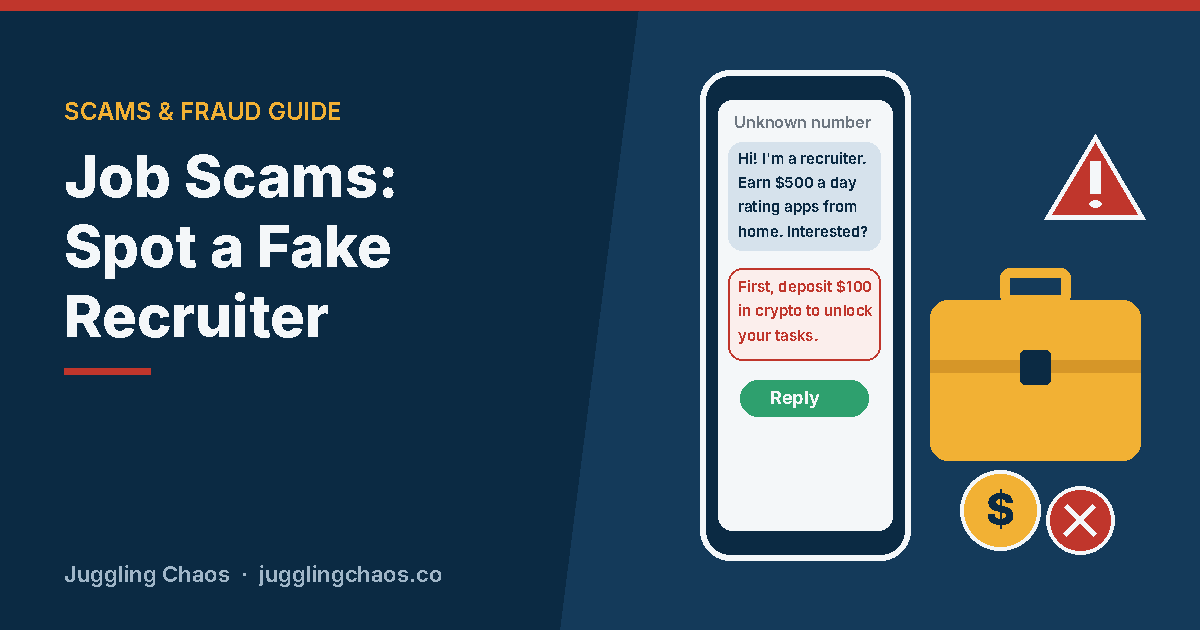
- A text or chat message out of the blue. Someone says they are a recruiter for a company you may know. They offer remote work with daily or weekly pay but few details about the actual job, and ask you to reply rather than click a link. The FTC says real employers don’t recruit through generic, unexpected texts, WhatsApp or Telegram messages.
- A message on a job site. Scammers pose as recruiters on real job platforms, say your skills are a great match, and send an official-looking interview invitation, a “job briefing,” and then an offer letter with the company’s name and logo.
- A fake listing. Scammers post jobs on legitimate job sites, often for remote roles such as data entry or translation. Everything moves fast: an interview over a text-only chat app, then an offer almost right away.
- “Task” or app-rating jobs. You are offered pay for simple online chores like liking videos, rating products, or “product boosting” and “optimization” tasks inside an app. The FTC also calls these gamified job scams.
The money tricks behind fake jobs
Task scams
The app shows your “commissions” growing with every task. Scammers may pay a small amount at first to build trust. Then you are told to deposit your own money, usually in cryptocurrency, to unlock the next set of tasks or to withdraw what you have earned. The earnings on the screen were never real. As the FTC puts it, there aren’t any commissions, and nobody but the scammers make any money.
Fake checks for “equipment”
You are hired, and the employer mails you a large check to set up a home office or buy supplies. You are told to deposit it, then send part of the money to a “vendor” or back to the employer. Fake checks can look real, even to bank employees. Your bank has to make the money available quickly, so it may show up in your account, but the FTC warns that it can take weeks for a bank to find out a check is fake. By then the money you sent is gone, and you have to pay the bank back. In a related version, the “recruiter” sends an invoice for a work computer and asks you to pay for it yourself by cash, Zelle or PayPal, with a promise to reimburse you that never comes true.
Reshipping
The job is to receive packages at home, repackage them and send them on, often overseas. The goods are usually bought with stolen credit cards. The FTC is direct about this: reshipping goods is never a real job. The promised paycheck doesn’t arrive, and the personal information you gave the “employer” can be used for identity theft.
Paperwork that steals your identity
Fake employers send direct deposit and tax forms, or ask for your driver’s license, Social Security number or bank account number to finish “employment paperwork.” They often push for this before an interview, or before you get answers to your questions. The FTC says real employers won’t ask for that kind of information before they have actually interviewed and hired you.
Warning signs
- The offer found you. A generic or unexpected text, WhatsApp or Telegram message about a job is a strong sign of a scam.
- You have to pay to work or to get paid. Fees for training, certification, equipment, or “unlocking” earnings. The FTC calls paying to get paid a sure sign of a scam.
- You’re asked to deposit a check and send money back. Or to use the money to buy gift cards, send cryptocurrency, or pay someone else.
- It’s paid to rate or like things. The FTC warns not to trust anyone who says they’ll pay you to give positive ratings or likes online.
- The recruiter uses a personal email or phone. Real recruiters usually write from a company email address, not a free personal account.
- They want your SSN or bank details early. Especially before an interview, or in exchange for answering your questions.
- It moves very fast. A chat-only interview, an instant offer, and pressure to start right away.
How to protect yourself
- Don’t reply to unexpected job texts. Not even with “YES” or “INTERESTED.” Delete them, no matter how professional the message looks.
- Never pay to get a job or to get paid. Honest employers, including the federal government, don’t charge you to be hired.
- Don’t deposit a check from someone you don’t know and then send money on. A check showing as “available” in your account doesn’t mean it’s good.
- Hold back your Social Security number and bank details until you have confirmed the job is real and you have been hired.
- Take your time. Talk the offer over with someone you trust. A real employer will wait a day while you check.
How to check that a job offer is real
Before you share anything personal:
- Search the name. Look up the company and the recruiter’s name along with words like “scam,” “review” or “complaint.”
- Contact the company yourself. Use a phone number you already know is real, not the one in the message, or go to the company’s own website. Ask whether the job and the recruiter exist. If you can’t confirm it, treat it as a scam.
- Look at the email address. An offer from a free personal email account, rather than the company’s own address, is a red flag.
- Start your search with trusted sources. Federal jobs are listed free at USAJobs.gov, and applying is free. CareerOneStop links to state job banks.
If it already happened
Acting quickly helps. Work through what applies to you:
- You only replied to a text: stop answering and block the number. Expect more messages, and ignore them.
- You deposited a check: don’t send any of the money anywhere. Tell your bank right away that you think the check is fake.
- You paid by credit or debit card: call the number on the back of the card, report the fraud, and ask for your money back.
- You paid by bank transfer, Zelle or a payment app: contact your bank or the app right away and ask them to reverse the payment.
- You paid with gift cards: call the card issuer using the number on the back, say a scammer got the card number and PIN, and ask for a refund. Keep the card and receipt.
- You sent cryptocurrency: contact the exchange or crypto ATM company, report the transaction as fraud, and ask for a reversal. Crypto payments don’t have the same legal protections as card payments, so act fast.
- You gave your Social Security number or bank details: go to IdentityTheft.gov for a personalized recovery plan, and consider a credit freeze.
- You reshipped packages: stop right away and don’t send anything else.
Report the scam to the FTC at ReportFraud.ftc.gov, and tell the job site where you saw the listing. You can also report it to your state attorney general.
Helping an older parent with job offers
- Talk about it without judgment. Many retirees look for part-time or remote work, and a friendly “recruiter” text can feel like good luck.
- Share one simple rule: “A real job never asks you to pay, and never sends a check to deposit and send back.”
- Offer to look up any company together before they share personal details, and to call the company using a number you find yourselves.
- Agree that any request for a Social Security number, bank account or crypto deposit gets a pause and a call to you first.
Checklist
- Unexpected job texts and chat messages get deleted, not answered.
- Nobody pays to get a job, unlock earnings or buy equipment.
- Checks from new “employers” are never deposited and partly sent back.
- SSN and bank details are shared only after a confirmed, real hire.
- IdentityTheft.gov and ReportFraud.ftc.gov are saved for quick use.
FAQ
Is it a scam if a recruiter texts me about a job I never applied for?
Very likely. The FTC says real employers don’t contact people through generic, unexpected texts, WhatsApp or Telegram messages about jobs.
The task app already paid me a little. Doesn’t that mean it’s real?
No. Task scammers often pay a small amount early on to build trust. The bigger “earnings” on the screen aren’t real, and the request to deposit your own money to unlock tasks or withdraw is the scam itself.
My bank says the check cleared. Can I send the money for equipment now?
Please don’t. Banks must make deposited funds available quickly, but the FTC warns it can take weeks to discover that a check is fake. If it is, you will owe the bank the full amount, including whatever you sent on.
When is it normal for an employer to ask for my Social Security number?
After you have interviewed and been hired, and you have confirmed the employer is real. The FTC says real employers won’t ask for that kind of information before they have actually interviewed and hired you. A request before an interview, or before you can ask questions, is a red flag.
Related guides
- Scam Texts: How to Spot a Fake Text Message
- How Scammers Tell You to Pay (FTC Video Guide)
- Imposter Scams: How to Spot Someone Pretending to Be an Agency or a Company You Trust
Sources
- Federal Trade Commission, “Job Scams,” consumer.ftc.gov, accessed October 23, 2026.
- Federal Trade Commission, “That job offer text is probably a scam,” consumer.ftc.gov, accessed October 23, 2026.
- Federal Trade Commission, “How to spot and avoid task scams,” consumer.ftc.gov, accessed October 23, 2026.
- Federal Trade Commission, “Task scams create the illusion of making money,” consumer.ftc.gov, accessed October 23, 2026.
- Federal Trade Commission, “Job scammers are looking to hire you,” consumer.ftc.gov, accessed October 23, 2026.
- Federal Trade Commission, “Scammers impersonate well-known companies, recruit for fake jobs on LinkedIn and other job platforms,” consumer.ftc.gov, accessed October 23, 2026.
- Federal Trade Commission, “Searching for a job to work remotely? Avoid scams and identity theft,” consumer.ftc.gov, accessed October 23, 2026.
- Federal Trade Commission, “How To Spot, Avoid, and Report Fake Check Scams,” consumer.ftc.gov, accessed October 23, 2026.
- Federal Trade Commission, “What To Do if You Were Scammed,” consumer.ftc.gov, accessed October 23, 2026.
This is general information, not legal or financial advice. If you lost money, contact your bank or payment provider right away and report the scam at ReportFraud.ftc.gov.
Get one safety checklist a month
Juggling Chaos Monthly is free: one 15-minute checklist, one scam warning sign, and our newest guides. Sign up on the newsletter page.
Juggling Chaos will never ask for a password, payment, gift card, or verification code. Guides are general information, not legal or financial advice; see our Disclaimer and Terms and Editorial Policy.