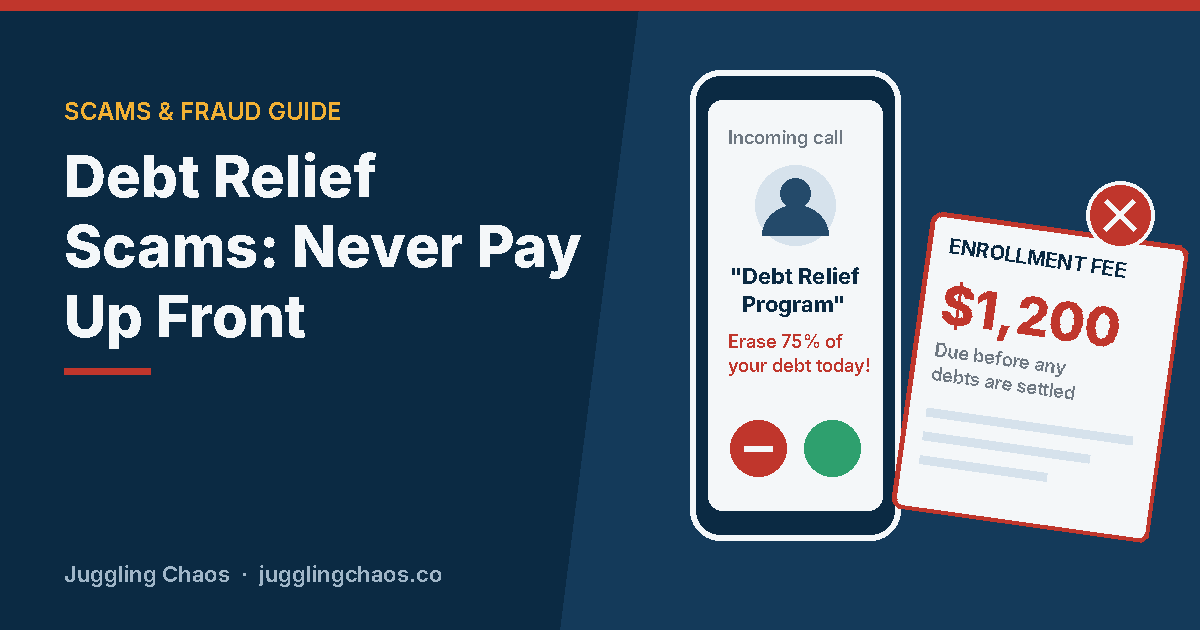
Debt Relief Scams: Upfront Fee Rules, Risks, and Free Help
A debt relief scam is a pitch to make your debt shrink or disappear, for a fee. The caller, ad or text promises to cut your credit card balances, lower your interest rate, or get your student loans forgiven fast. Some say they work with your bank or a “new government program.” Then they collect money up front and do little or nothing.
This guide is for anyone weighing a debt relief offer, and for family members helping a parent sort through calls and letters about their bills. It explains the rules on fees, the real risks of debt settlement, and the free or low-cost help that already exists. The advice below was checked against FTC consumer advice, the FTC’s Telemarketing Sales Rule guidance, Consumer Financial Protection Bureau (CFPB) pages and StudentAid.gov on October 23, 2026.
How debt relief scams work
- The unexpected call. Someone calls out of the blue offering to settle your debts or drop your interest rate. The FTC says a caller like this is probably a scammer, and you shouldn’t share personal or financial information.
- The borrowed name. The caller says they are with your card company, your bank, or a government program. Student loan scammers often claim to be connected to the Department of Education.
- The upfront fee. You are asked to pay an enrollment fee, a monthly fee, or a “processing” charge before any debt is settled.
- The “stop paying” advice. Many programs tell you to stop paying your creditors and stop talking to them, and to send money to the company instead. Late fees and interest pile up while you wait.
Warning signs
- They want money before they do anything. The FTC says only scammers will tell you to pay up front before they settle any of your debts or enroll you in a debt management plan.
- They guarantee results. No one can promise that creditors will forgive your debts, or that student loans will be forgiven quickly.
- They mention a “government” program. The FTC lists promises of a government debt relief program as a scam sign.
- They sign you up without looking at your finances. A real counselor reviews your income, bills and spending first.
- They tell you to stop talking to your creditors without explaining what that will do to your credit and your balances.
- They ask for your passwords. The Department of Education and its loan servicers will never ask for your StudentAid.gov password or FSA ID.
- They rush you. “Act now before the program ends” is a pressure tactic.
How to protect yourself
- Hang up on unexpected offers. If a caller says they are from your bank or card company, end the call and dial the customer service number on the back of your card.
- Never pay before a debt is settled. Paying before anyone helps you will likely just cost you money.
- Start with a budget so you know what you can realistically pay each month.
- Call your creditors yourself. It’s free, and many will work with you. See the section on free help below.
- Get everything in writing and understand how a plan will affect your credit before you agree.
- Check out any company first. Look for complaints with your state attorney general and local consumer protection office. No complaints is not proof a company is honest.
The upfront fee rule
The FTC’s Telemarketing Sales Rule covers for-profit debt relief companies that sign people up by phone. That includes calls they make to you and calls you make after seeing an ad or getting a mailer. Under the rule, the company can’t collect a fee until all three of these happen:
- It has actually changed the terms of at least one of your debts, for example by reaching a settlement.
- You have agreed to that settlement or plan.
- You have made at least one payment to the creditor or collector under the new agreement.
If several debts are enrolled, the company can only collect part of its fee as each one is settled. Before you sign up, it must tell you its fees, how long results will take, how much you must save before it makes offers, and what can happen if you stop paying your creditors.
Companies sometimes ask you to save money in a special account. Under the rule, that money and any interest belong to you. The account must be at an insured financial institution, run by an administrator the settlement company doesn’t own or control, and you can withdraw your money at any time without penalty. If you leave the program, your funds must be returned within seven business days, minus any fees the company properly earned.
For credit counseling, the FTC says a company can’t charge a fee for a debt management plan until you are enrolled and have made at least one payment through it.
The real risks of debt settlement
Debt settlement companies, usually for-profit, try to get creditors to accept a lump sum that is less than you owe. Even when they follow the rules, the FTC and CFPB warn that it can be risky:
- Your credit can take a hit. Missed payments show up on your credit report and can make it harder to borrow later.
- Balances can grow. Interest and penalty fees keep adding up while you save toward a settlement.
- You can be sued. Creditors may send your account to collections or file a lawsuit, which could lead to wage garnishment or a lien.
- Not every debt gets settled. Some creditors won’t negotiate, and many people don’t finish the program.
- Forgiven debt can be taxed. The FTC notes that the amount you save may be considered taxable income.
The CFPB adds that settlement companies usually can’t get better terms than you could negotiate yourself, and that many companies advertising “consolidation” are really debt settlement companies.
Free and low-cost help that’s real
- Your creditors. Explain your situation before a debt collector gets involved. Ask about a lower payment, a payment plan, or a new due date. Some creditors will accept less than the full amount.
- Nonprofit credit counseling. Counselors can help you build a budget and may set up a debt management plan, where you make one monthly payment and they pay your creditors, often at lower rates. Look for programs through credit unions, universities, Cooperative Extension offices and military personal financial managers. Ask for all fees in writing. A legitimate counselor won’t tell you to stop paying your debts.
- Federal student loans. Repayment plans and forgiveness programs are free through StudentAid.gov and your loan servicer. To find your servicer, log in to StudentAid.gov and check your dashboard. You never need to pay a company for this help.
- Mortgages. Contact your lender right away, and get free help from a HUD-approved housing counselor. Never pay a company up front for mortgage relief.
If you already paid or shared information
Act quickly, and work through what applies:
- You paid by credit or debit card: call your card issuer or bank using the number on the back of the card. Report the charge and ask for a refund.
- You paid by bank transfer: contact your bank or credit union as soon as possible and ask them to reverse the payment.
- You stopped paying your creditors: call each creditor directly, explain what happened, and ask about getting back on a payment plan.
- You have money in a settlement account: that money is yours. Ask the account administrator to return it.
- You shared your StudentAid.gov login: change your password right away, check that your contact details are correct, and ask your servicer to remove any authorization the company has on file.
- You gave your Social Security number: visit IdentityTheft.gov for a recovery plan, and consider a credit freeze.
Report it to the FTC at ReportFraud.ftc.gov, to your state attorney general, and to the CFPB. Be wary of anyone who later offers to get your money back for a fee.
Helping an older parent with debt relief offers
- Agree on a simple rule: “We never pay anyone to fix debt before the debt is fixed.”
- Write the real customer service numbers for their cards and loans on one sheet, so they can call back instead of trusting a caller.
- Offer to sit in on calls with creditors or a credit counselor.
- Look at the budget together without judgment. Problems are easier to fix when they are caught early.
Checklist
- No fees are paid before at least one debt is settled.
- Unexpected debt relief calls get a hang-up and a call back to a known number.
- Creditors are contacted directly before any company is considered.
- Any plan or settlement is in writing and read before signing.
- Student loan questions go only to StudentAid.gov or the loan servicer.
FAQ
Is debt settlement the same as credit counseling?
No. Credit counselors are usually nonprofits that help you budget and may set up a debt management plan to repay what you owe, often at lower interest. Debt settlement companies are usually for-profit and try to get creditors to accept less than you owe, which carries more risk to your credit.
Are nonprofit credit counselors always safe?
Not always. The FTC says nonprofit status doesn’t guarantee that services are free, affordable or legitimate. Ask about all fees in writing, ask whether counselors are certified, and check for complaints with your state attorney general.
Do I need a company to get my student loans forgiven?
No. Federal forgiveness programs and repayment plans are free, and your servicer will help you apply at no cost. A promise of instant cancellation for a fee is a red flag.
A caller says they’re from my bank and can lower my rate. What should I do?
Hang up and call the number on the back of your card. Your card company can tell you directly, for free, whether a lower rate or payment plan is possible. Don’t give a caller your account number or Social Security number.
Related guides
- Credit Repair Scams: Red Flags, Your Rights, and What You Can Do for Free
- Imposter Scams: How to Spot Someone Pretending to Be an Agency or a Company You Trust
- Refund, Settlement, and Recovery Scams
Sources
- Federal Trade Commission, “How To Get Out of Debt,” consumer.ftc.gov, accessed October 23, 2026.
- Federal Trade Commission, “Choosing a Credit Counselor,” consumer.ftc.gov, accessed October 23, 2026.
- Federal Trade Commission, “Looking for debt relief? Here’s how to avoid a scam,” consumer.ftc.gov, accessed October 23, 2026.
- Federal Trade Commission, “Carrying credit card debt? How to avoid debt relief scams,” consumer.ftc.gov, accessed October 23, 2026.
- Federal Trade Commission, “Student loan scammers won’t offer relief,” consumer.ftc.gov, accessed October 23, 2026.
- Federal Trade Commission, “What To Do if You Were Scammed,” consumer.ftc.gov, accessed October 23, 2026.
- Federal Trade Commission, “Debt Relief Services & the Telemarketing Sales Rule: A Guide for Business,” ftc.gov, accessed October 23, 2026.
- Consumer Financial Protection Bureau, “What is the difference between credit counseling and debt settlement, debt consolidation, or credit repair?,” consumerfinance.gov, accessed October 23, 2026.
- Consumer Financial Protection Bureau, “I’ve seen a lot of advertisements for companies that consolidate credit card debt. Are these legitimate?,” consumerfinance.gov, accessed October 23, 2026.
- Federal Student Aid, “How To Avoid Student Loan Forgiveness Scams,” studentaid.gov, accessed October 23, 2026.
This is general information, not legal or financial advice. If you lost money, contact your bank or payment provider right away and report the scam at ReportFraud.ftc.gov.
Get one safety checklist a month
Juggling Chaos Monthly is free: one 15-minute checklist, one scam warning sign, and our newest guides. Sign up on the newsletter page.
Juggling Chaos will never ask for a password, payment, gift card, or verification code. Guides are general information, not legal or financial advice; see our Disclaimer and Terms and Editorial Policy.