Fake Coaching: How to Spot a Coaching Scam Before You Pay
A fake coach sells you a promise, not a service. The promise is usually fast money, a new career or a life reset. The tell is the same almost every time: big guarantees, pressure to pay now, credentials you cannot check, and a steady stream of add-on purchases once you are in. This guide shows you how to recognize those patterns, how to vet any coach in about an hour, and what to do if you have already paid.
We also cover a related worry: scams that target players and parents in online games, since people searching for one often land on the other.
TL;DR
- Real coaches can describe their method and their limits. Fake ones guarantee income, results or a “proven system.”
- Pressure to decide today, “only two spots left” claims and constant upsells are classic warning signs.
- Before paying, search the company name with “review,” “scam” and “complaint,” check your state attorney general, and talk to past students.
- If you paid, contact your payment provider right away, then report to the FTC and the FBI’s IC3.
- Never pay a stranger who offers to recover your money. That is a second scam.
Table of Contents
- What a fake coach looks like
- Warning signs you can spot in one conversation
- How to check a coach before you pay
- Toxic coach or fraudulent coach?
- Scams in online games
- If you already paid a fake coach
- Our perspective
- Keep your family ready
- FAQ
- Sources
What a fake coach looks like
Coaching is not regulated the way medicine or law is. In most cases anyone can call themselves a coach, and that is what scammers count on. Some “coaches” are simply inexperienced and overselling. Others run organized schemes built to take money in stages.
The business version is the most common. The Federal Trade Commission says scammers promote training programs that claim to teach you how to succeed with ecommerce, financial markets or similar ventures. Life coaching, career coaching and even sports recruiting have their own versions.
Here are the forms you will meet most often:
- Business or income coaching. You pay to learn a system for online stores, investing, real estate or “passive income.”
- Life coaching. Big promises of a total transformation, often with a high-priced package paid upfront.
- Credential mills. A coach claims impressive certifications from schools or bodies that do not really exist.
- Job and career coaching. Someone promises to place you in a job for a fee. Our guide to fake job offers and what to check before you pay covers that overlap.
Warning signs you can spot in one conversation
No single sales line proves fraud. The New Hampshire Department of Justice makes this point in its life-coaching alert: fraud usually shows up as a cluster of behaviors, such as guarantees, unverifiable status, scarcity pressure, opaque fees and forced upsells. Count how many you see.
Guaranteed income or “proven system” claims
The FTC lists guaranteed income or large returns and claims of a “proven system” among the signs of a coaching scam. Its 2023 alert adds that promises of lots of money with little or no risk are a mark of dishonest offers.
No honest coach can guarantee your results. They do not control your market, your effort or your luck. Our guide to get-rich-quick income scams explains why “little risk, big reward” should end the conversation.
Pressure to decide now
The FTC names pressure to decide immediately as a warning sign. New Hampshire’s alert describes high-pressure scarcity claims. You may hear “this price ends tonight” or “we only take five people.” A legitimate coach will let you sleep on it, read the contract and ask a friend.
Credentials you cannot verify
A coach may list certifications, a famous employer or a degree. Fake ones lean on these because buyers rarely check. Ask for the exact name of the certifying body, then look it up independently. The FTC advises you to research any certifications a coach claims.
Testimonials that cannot be traced
Glowing reviews, income screenshots and before-and-after stories are cheap to fake. The FTC warns that positive testimonials and online reviews may be fake or misleading. A testimonial with a first name and a stock-looking photo proves nothing.
Upsells, hidden fees and no refunds
This is how a small purchase becomes a large loss. You buy an entry course. Then you learn the “real” results need a mentorship tier, a software package or a done-for-you service. The FTC lists requests for more money to help the business succeed, and New Hampshire flags costly upsells, hidden fees and non-refundable packages.
| Sign | What an honest coach does | What a fake coach does |
|---|---|---|
| Results | Describes typical outcomes and limits | Guarantees income or a transformation |
| Timing | Gives you time to decide | Sets a deadline or claims scarcity |
| Credentials | Names the body and lets you verify it | Stays vague or cites unknown schools |
| Reviews | Connects you with past clients | Shows screenshots you cannot trace |
| Price | States the full cost and refund terms upfront | Adds tiers and fees after you pay |
How to check a coach before you pay
The FTC’s advice is simple and works. Set aside an hour and do these steps in order.
- Search the name. Look up the coach and the company with the words “review,” “scam” and “complaint.” Read past the first page.
- Check with your state attorney general. The FTC recommends it, and your state’s consumer protection office can tell you whether complaints exist.
- Verify every credential. Find the certifying organization yourself, not through a link the coach gave you.
- Talk to former or current students. Find them on your own, not from a list the coach provides. Ask what they paid in total, what they got and whether they could get a refund.
- Read the full contract. Look for refund terms, automatic renewals and a list of every paid tier.
- Take your time and get a second opinion. The FTC says to do both before paying. Show the offer to someone who has no stake in it.
If the coach is dodging steps 3 and 4, you have your answer.
Check who is behind the website
Coach-training schools are a special case. If you are paying to become a coach, be wary when the site does not say who owns or runs it, or when it presents itself as a university while giving no real accreditation details. A real school is easy to identify and easy to contact.
Toxic coach or fraudulent coach?
These are two different problems, and people often mix them up.
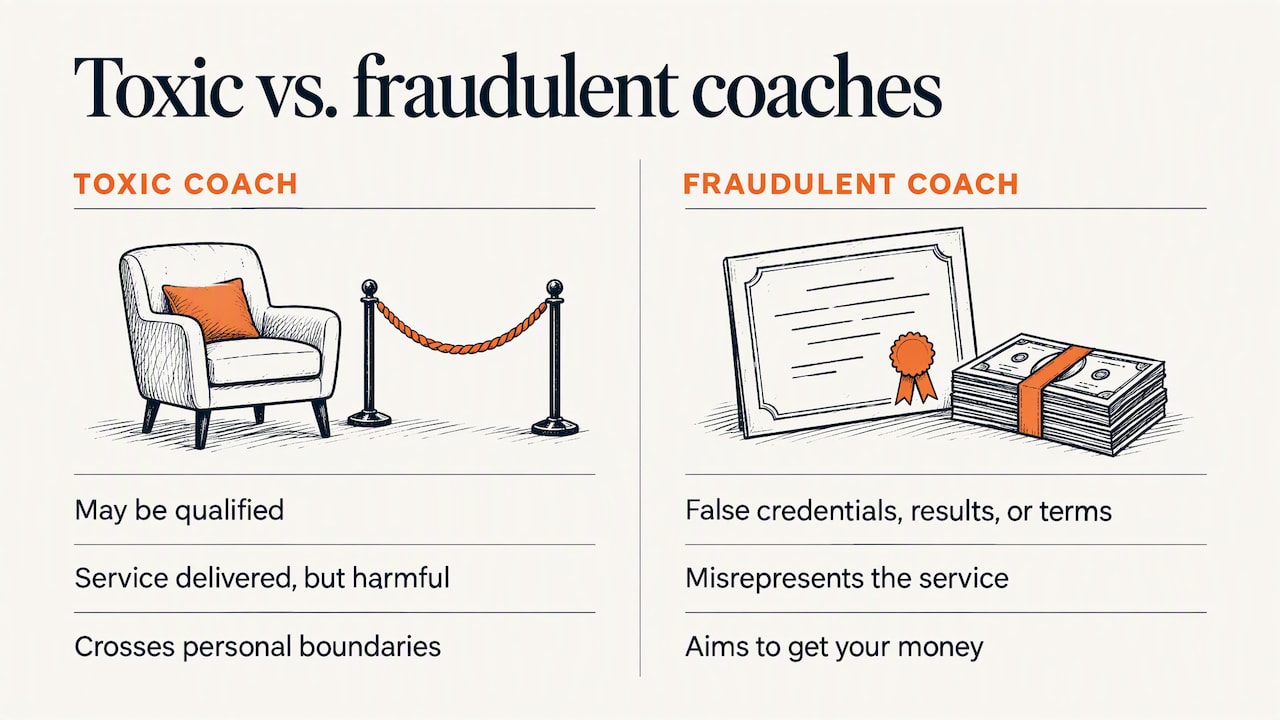
A toxic coach can be real, qualified and still harmful. They belittle you, ignore your boundaries, push you past what you agreed to or make you feel dependent on them. You got the service but it hurt you.
A fraudulent coach misrepresents what they are selling. The credentials, results or terms are false, and the aim is to get your money.
The overlap is real, though. Both often use pressure, guilt and isolation. A useful test is to ask two questions. Did they deliver what they honestly described? Are they asking for more money based on fear or shame? A yes to the second question, with a no to the first, points to fraud. If you only have the first problem, you can end the relationship and ask for a refund under the contract terms. If a coach is hurting your mental health, talk to a licensed professional such as a therapist or your doctor. Coaching is not a substitute for care.
Scams in online games
People searching for scamming games are usually asking about one of two things: scams inside games, or “games” that are really schemes. Both exist.
The New York Department of State’s consumer alert says gaming scams can involve fraudulent sellers, offers for virtual items or currency outside official platforms, phishing links, malicious downloads and fake online stores. The warning signs are requests for personal or account information, suspicious links or attachments, and offers of in-game currency in exchange for money or personal details.
Two other patterns are worth knowing:
- Chain-letter “games.” The FTC describes these as schemes that promise a large return for a modest investment and require you to recruit others. Participants are virtually guaranteed to lose money or draw friends and family into the loss.
- Crypto “games.” The FBI warns that fake in-game rewards pressure players to keep depositing money. When the player tries to withdraw, they are told to pay extra taxes or fees. That is another attempt to take money, not a path to getting it back.
There is a coaching link here too. Some “game coaches” and “boosting” sellers ask for account logins or payment outside the platform. Treat that as you would any stranger asking for your password.
How families can protect gaming accounts
New York’s alert gives plain steps you can start tonight:
- Keep personal information private. Never share dates of birth, Social Security numbers, family names or account details with other players.
- Block and report accounts that ask for that information.
- Review the privacy settings on the gaming device.
- Avoid linking personal social media accounts to gaming accounts.
- Do not download files shared by other players.
- Do not save credit card information on a console or device.
If an account was exposed, the FTC says to change the exposed password immediately, change it anywhere else it was reused, and turn on two-factor authentication. Our Family Safety: Start Here page walks through the account basics for the whole household.
If you already paid a fake coach
Money sent to a scammer is often gone, but not always. Speed matters. The FTC’s ReportFraud FAQ says to contact the payment provider immediately, and the right move depends on how you paid:
| How you paid | Who to contact |
|---|---|
| Credit or debit card | Your card issuer, to dispute the charge |
| Gift card | The gift-card company |
| Wire transfer | The wire service |
| Mailed cash or money order | The carrier or issuer, to try to stop delivery or payment |
| Electronic bank transfer or withdrawal | Your bank, right away |
The FBI’s IC3 adds that you should report the transaction to the online payment service and ask your bank to contact the receiving institution.
Report it
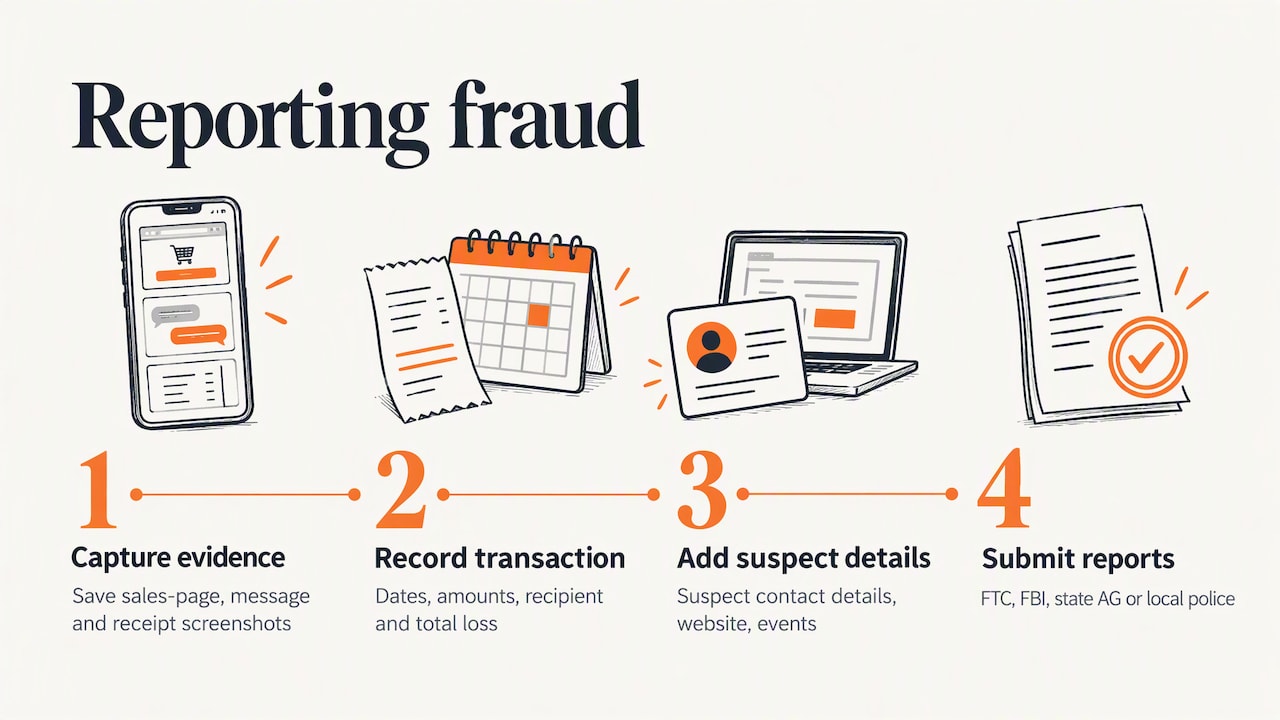
The Consumer Financial Protection Bureau says U.S. victims should report fraud to the FTC at ReportFraud.ftc.gov or to the FBI at IC3.gov, contact their state attorney general and contact local police through a nonemergency number or website. If the seller will not resolve an online purchase complaint, USAGov says you can contact your state consumer protection office or attorney general.
Gather the details first. IC3 says a complaint should include transaction dates and amounts, the recipient’s information, total loss, the suspect’s contact details or website and a specific account of what happened. Take screenshots of the sales page, messages and receipts before anything disappears.
Reports matter even when you do not get money back. Our short guide on why reporting fraud helps stop scammers explains how.
Do not pay anyone to get your money back
People who have paid one scammer are often targeted again. The FTC explains that scammers buy and trade lists of previous victims, then use those details to make a fake recovery offer sound believable. They ask for an upfront fee or financial information. Legitimate government agencies and organizations do not guarantee recovery or require payment to help you get a refund.
If someone calls, emails or messages you offering to recover your coaching fees for a charge, stop. Read our guide to refund and recovery scams first.
Secure your accounts and devices
If the “coach” got a password, or remote access to your computer or phone, the FTC’s steps are to update your security software, run a scan, remove anything it finds, change your passwords and turn on two-factor authentication. If you need help, use the device maker or a trusted support provider. Our guide to a hijacked computer goes through it in order. If your Social Security number or other identity details went to the coach, see how IdentityTheft.gov helps you report and recover.
Our perspective
We built Juggling Chaos for people who are not technical and do not have time to become experts. Coaching scams are a good example of why that matters. They do not rely on clever hacking. They rely on a nervous person, a clock and a confident voice.
Here is what we tell family and friends. First, slow the conversation down. Any offer that cannot survive 48 hours of waiting is not an offer you need. Second, ask for everything in writing: the total price, every tier, the refund terms and the credentials. Third, treat a request for more money as a stop sign, not a hurdle. Honest providers can tell you the full cost at the start.
We also see how quickly shame keeps people quiet. Scammers are professionals, and they are good at this. Telling someone you trust, and reporting it, protects you and the next person.
— Robert
Keep your family ready
If you want a calm, step-by-step way to cover the basics, start with our Family Safety: Start Here page. It collects our checklists in one place, in plain language, so a parent, a teen and a grandparent can all use it. For fresh examples of what scammers are trying now, browse our Scams & Fraud hub.
FAQ
How can I tell if a coach is fake?
Look for a cluster of signs: guaranteed results, a “proven system,” pressure to pay immediately, credentials you cannot verify, testimonials you cannot trace and repeated upsells. Then run the checks: search the name with “review” and “scam,” call your state attorney general’s office and speak to past students you found yourself.
Are all life coaches scams?
No. Many coaches are honest and helpful. The field is largely unregulated, though, so you have to do the vetting yourself. A good coach describes their method and its limits, gives you the full price and refund terms upfront, and does not rush you.
Can I get my money back from a fake coach?
Sometimes. Contact your card issuer, bank or payment service immediately, because speed matters. A card charge can often be disputed, while gift cards and wire transfers are harder. Report to the FTC and IC3 as well, and ignore anyone who offers to recover your money for a fee.
How do scams in online games work?
Scammers offer cheap virtual items or currency outside the official platform, send phishing links or malicious files, run fake stores, or promote “games” that pay out only if you keep depositing or recruiting friends. The common thread is a request for your money, password or personal information.
What should I do if my child was scammed in a game?
Stay calm and keep the conversation open, since a scared child hides things. Change the exposed password and any reused ones, turn on two-factor authentication, contact the payment provider if money was spent, and report the account to the game platform and the FTC.
Sources
- When a Business Offer or Coaching Program Is a Scam (FTC)
- Consumer Alert: Life Coaching Scams Warning (New Hampshire Department of Justice)
- Not all business coaches are trying to help you (FTC)
- Consumer Alert on gaming scams (New York Department of State)
- This “game” is a chain letter scam (FTC)
- Criminals steal through cryptocurrency games (FBI IC3)
- What To Do if You Were Scammed (FTC)
- ReportFraud.ftc.gov FAQ (FTC)
- Internet scam victim guidance (FBI IC3)
- Who do I contact for help with a scam or fraud? (CFPB)
- Internet Crime Complaint Center FAQ (FBI IC3)
- Refund and Recovery Scams (FTC)
- Where to file a complaint about an online purchase (USAGov)