

Financial Fraud: Types, Warning Signs and What to Do
Financial fraud is deception used to take your money or assets. Someone lies, hides facts, or pretends to be someone they are not, and you pay because you believe them. It includes investment schemes, fake job offers, imposter calls, and life insurance scams. This guide explains what counts, what the common types look like, the warning signs that matter, and the steps to take if you have already paid.
TL;DR
- Financial fraud is intentional deception for money. A bad purchase or a poor-quality service is not fraud by itself. Lying about what you are getting is.
- Most schemes work the same way: gain your trust, then push you to act fast. Slow down and verify through a number or website you look up yourself.
- Life insurance scams include fake agents, diverted premiums, forged beneficiary changes, and stranger-owned policy pitches. Check the agent and insurer with your state insurance department.
- If you paid, call the bank, card company, or payment app right away, then report to the FTC and, for online crime, the FBI’s IC3.
- Anyone who offers to get your lost money back for a fee is probably running a second scam.
Table of Contents
- What counts as financial fraud
- How big the problem is
- How most financial fraud works
- Examples of financial fraud
- Life insurance scams
- Warning signs to watch for
- How to protect yourself and your family
- Our perspective
- What to do if you lost money
- Where to go next on Juggling Chaos
- FAQ
- Sources
What counts as financial fraud
The Bureau of Justice Statistics defines financial fraud as acts that intentionally and knowingly deceive the victim by misrepresenting, concealing, or omitting facts about promised goods, services, or benefits that do not exist, are unnecessary, were never going to be provided, or are deliberately distorted for money. The U.S. Postal Inspection Service describes it more simply: a crime involving finances or illicitly gained funds, usually scamming someone out of money through theft or deceit.
The key word is intent. The FINRA Foundation’s research on fraud explains that fraud differs from mistakes or poor service because the other side deliberately deceives you into a transaction you would not have accepted if you knew the truth.
Two related things get mixed up with it:
- Scams is the everyday word for fraud that persuades you to hand money over. Most of this article is about those.
- Identity theft is a close cousin. The same FINRA framework notes that it is conceptually distinct from persuasion-based fraud, because someone can steal your information without ever tricking you into a payment. It still leads to financial fraud when thieves open accounts or take loans in your name.
How big the problem is
The Federal Trade Commission reports that consumers reported losing more than $12.5 billion to fraud in 2024, a 25% increase over the year before. Those are only the losses people reported. Many victims never say anything, often out of embarrassment.
That is worth remembering if you ever feel foolish. These schemes are built by professionals who do this all day. Careful people get caught too.
How most financial fraud works
The Consumer Financial Protection Bureau says common frauds and scams usually try to get you to send money through threats, fake prizes or services, donation requests, or impersonation of someone you know or of a financial institution.
The pattern repeats:
- Contact. A call, text, email, social media message, dating match, or ad.
- Trust. They sound like a bank, the government, a boss, a grandchild, or a helpful expert.
- Pressure. There is a deadline, a threat, or a limited-time chance.
- A hard-to-reverse payment. Gift cards, wire transfers, payment apps, or cryptocurrency.
Our guide on how scammers tell you to pay covers step four in detail, and how to spot a scam covers the warning signs that show up in steps one to three.
Examples of financial fraud
The FINRA Foundation groups fraud into categories: investment, consumer products and services, employment, prizes and grants, phantom debt, charity, and relationship or trust fraud. Here is what each looks like in real life.
Investment fraud
The Office of the Comptroller of the Currency says investment fraud commonly uses false information and promises of high returns with little or no risk. Its examples include Ponzi schemes, pyramid schemes, and investment-platform scams sometimes called “pig butchering.”
The FTC describes how the crypto version often goes. A stranger contacts you through social media or a dating app and says they made money investing. They send you to a site or app where fake reports show your money growing, and they urge you to put in more. The company is not real.
If an investment promises big returns with no risk, treat that as the warning sign itself. Our guide to income and get-rich-quick scams shows how those pitches are built.
Imposter fraud
A caller says they are from your bank, the IRS, Social Security, or a tech company. They say your account is compromised or you owe money. The fix always involves moving or paying money right now.
A version that targets older adults is the emergency call from a “grandchild” who needs bail or hospital money. See family emergency scams for how to defend against it, and imposter scams for the broader picture.
Advance-fee and prize fraud
The FBI lists advance-fee, Nigerian letter, Ponzi, pyramid, and telemarketing fraud among common scams, and advises that offers that sound too good to be true should be treated as suspicious. In an advance-fee scheme you pay a “fee” or “tax” to receive a prize, loan, or inheritance that never arrives.
Employment fraud
A fake recruiter offers a remote job, then asks you to buy equipment, pay for training, or deposit a check and send some of it back. The check bounces later and the money you sent is gone. Read how to spot a fake job offer before you pay.
Relationship and trust fraud
A new match or online friend builds a relationship over weeks, then has a crisis that needs money. This is one of the most emotionally painful types. Our guide on romance scams explains how it unfolds.
Shopping and consumer fraud
A fake store or social media seller takes your payment and never ships anything, or sends something worthless. Use our checklist for checking a seller before you buy. A related trick is the lookalike website for a government service or utility, covered in fake government and bill-pay sites.
Phantom debt and recovery fraud
Phantom debt means collectors demand money for a debt you do not owe. Recovery fraud targets people who already lost money. Someone offers to get it back for a fee. The FTC warns that anyone who offers to recover lost money in exchange for money or personal information is probably running a recovery scam. More in refund and recovery scams.
Life insurance scams
Life insurance fraud gets less attention than bank or investment fraud, but it can wipe out a family’s protection or a retirement plan. The National Insurance Crime Bureau defines it as intentional deception to obtain a policy, inflate a payout, or file a false claim. It can involve policyholders, beneficiaries, agents, or illegitimate insurers.
The types most likely to affect a regular household:
| Scam | What happens | What it costs you |
|---|---|---|
| Fake agent or insurer | Someone sells you a policy that does not exist | You pay premiums for no coverage and your family gets nothing |
| Premium diversion | A dishonest agent keeps your payments instead of sending them to the insurer | The policy lapses without you knowing |
| Account takeover | Someone gains access to your policy account and changes the beneficiary | The payout goes to the wrong person |
| Application fraud | Someone lies on an application, or applies using your identity | Denied claims, or a policy you never asked for |
| Stranger-originated life insurance (STOLI) | Investors recruit you to take out a policy they plan to own | Legal and financial trouble, and the “free” deal turns out not to be |
NICB identifies fake agents selling nonexistent coverage, premium diversion, beneficiary changes through account takeover, false applications, faked death, and STOLI. The Coalition Against Insurance Fraud’s report on life and disability fraud also lists fraudulent loans, stranger-owned insurance, and agent or broker fraud.
One detail is easy to miss. NICB notes that account takeover can be carried out by family members or caregivers as well as cybercriminals. If an older relative depends on someone for help with paperwork, check the beneficiary on file once a year.
STOLI pitches deserve their own warning. The California Department of Insurance says they may describe coverage as free, risk-free, or no-cost and promise an upfront cash bonus while investors or agents arrange to transfer the policy to investors. If someone offers you cash to take out a policy, walk away.
If you are shopping for health coverage rather than life insurance, our guide to health insurance and Medicare enrollment scams covers a different set of tricks.
Warning signs to watch for
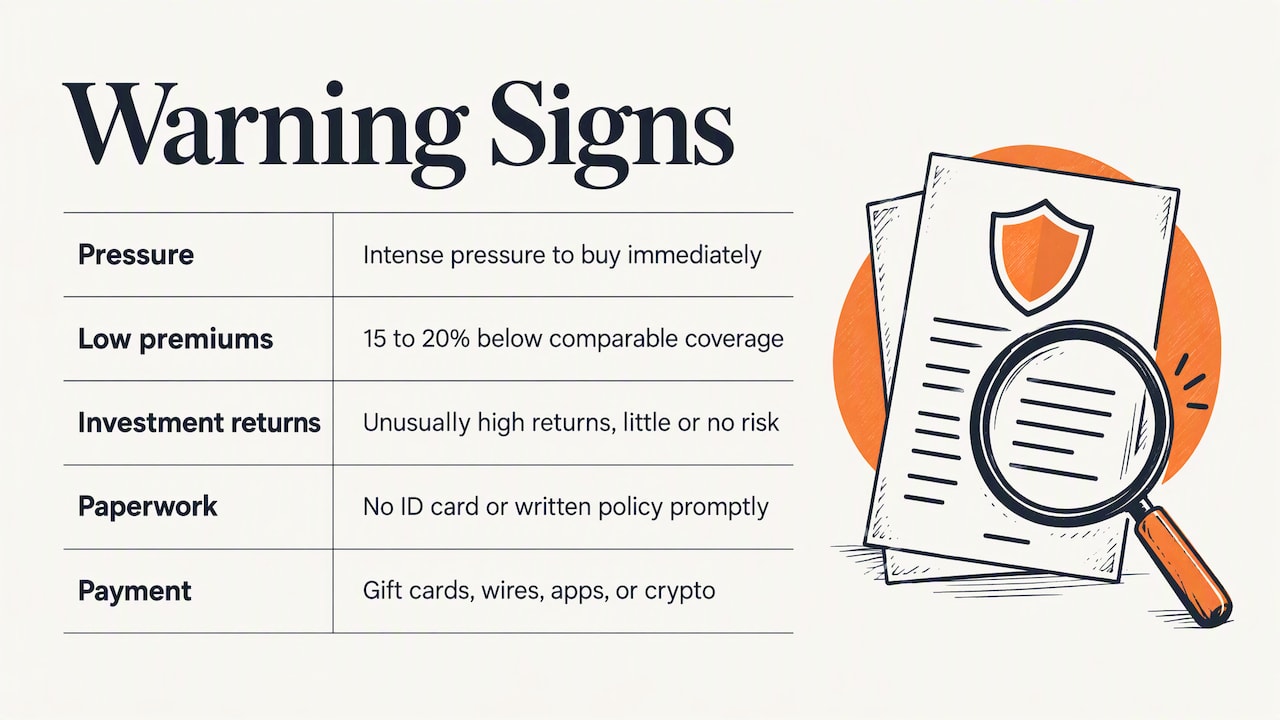
No single sign proves fraud. Two or three together should stop you.
Pressure to act now. The NAIC lists intense pressure to buy immediately as a sign of an illegitimate insurance company or agent. This applies to any financial offer.
A price that is too good. The same NAIC page flags premiums 15 to 20% below comparable coverage. For investments, the OCC points to unusually high returns paired with little or no risk as a central signal.
Contact details that are hard to find. A real company has a verifiable address and phone number.
No paperwork. The NAIC warns that a dishonest agent may collect premiums without forwarding them, and that not receiving an ID card or written policy promptly is a warning sign.
An odd way to pay. Gift cards, wire transfers, payment apps, or crypto for something that should be billed normally.
Signs your identity was stolen. USAGov lists unfamiliar bills, debt-collection calls for accounts you did not open, unknown accounts on your credit report, denied loan applications, and missing mail.
How to protect yourself and your family
These habits block most of what is described above.
Verify before you pay or sign
The NAIC advises you to stop before signing or paying, confirm the company is legitimate through your state insurance department, and get coverage details in writing. Apply the same rule everywhere. Look up the phone number yourself. Do not use the one in the message.
Pay the company directly
NICB recommends paying premiums directly to the insurance company, checking the policy’s online account, and reviewing beneficiaries and coverage every year. Put a reminder on your calendar.
Slow every conversation down
Scammers need speed. Say, “I’ll call you back,” and hang up. A real bank, agent, or agency will not mind.
Lock down your accounts
Use a unique password for each financial account and turn on two-step verification. Our family online safety steps and guide to staying safe online in the U.S. walk through it. Be careful with unexpected links: see scam texts and phishing, malware, and ransomware.
Talk with the people you look after
Agree on a family rule: nobody sends money or gift card numbers on the strength of a call or text alone. Call each other back first. This works well for teens and for older parents.
Our perspective
We read a lot of scam reports, and one thing stands out. People rarely fall for fraud because they are careless. They fall for it because the message arrived at a moment when they were worried, busy, or hopeful, and the scammer made the next step feel easy.
That is why we do not think the answer is memorizing a list of scam names. Names change every year. The pattern does not: someone you did not expect contacts you, makes you feel urgency, and asks for a payment that is hard to undo. If you learn to stop at that moment, you stop most of it.
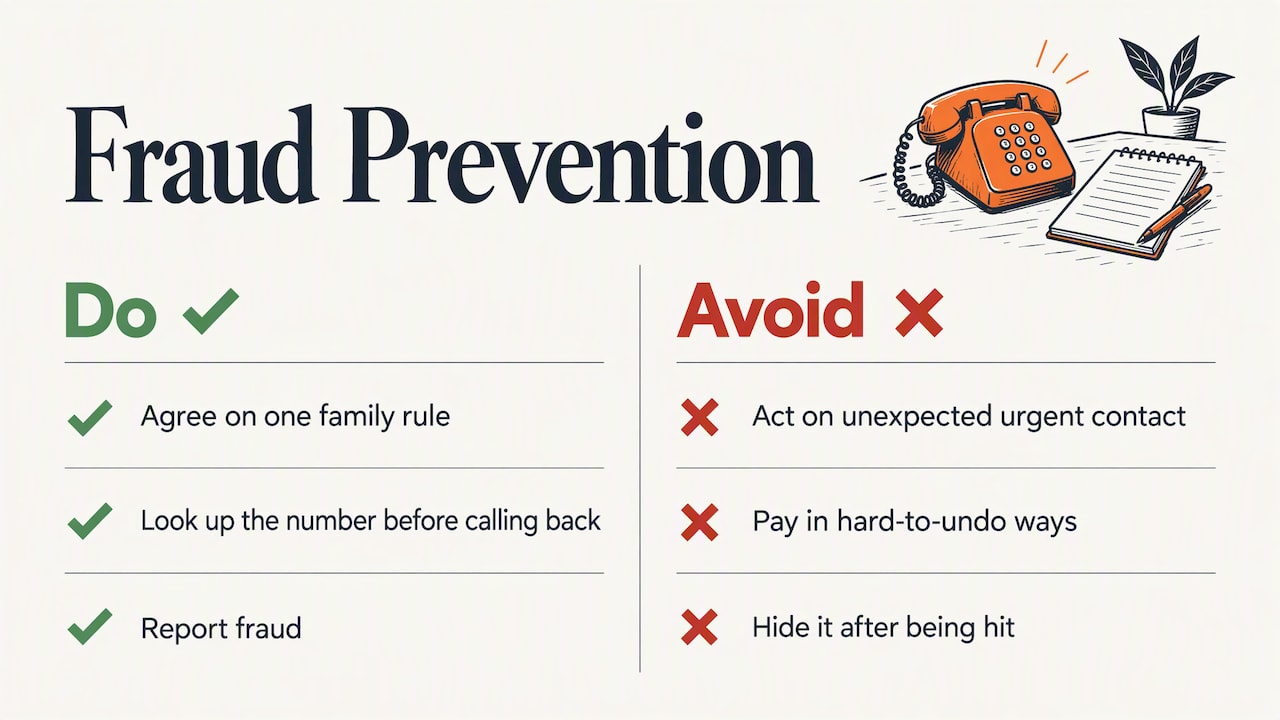
We also think families should talk about this before anything happens. Pick one rule together, such as “we always call back on a number we look up.” It costs nothing, and it works for a ten-year-old with a gaming account and for a grandparent with a retirement plan.
And if you have been hit, please do not hide it. Reporting helps you and helps others. See why reporting fraud matters.
— Robert
What to do if you lost money
Act in this order. Speed matters most in the first steps.
- Contact the company that moved the money. The FTC says that if you paid by card, contact the card issuer and ask for a reversal. If you were hit by an unauthorized bank transfer, contact your bank. For gift cards, wire transfers, payment apps, or crypto, contact that company promptly and ask for recovery.
- Report to the FTC. The FTC takes reports at ReportFraud.ftc.gov and offers advice on recovering after you have been targeted.
- Report online crime to the FBI. The FBI says victims of internet-enabled crime should report promptly to the Internet Crime Complaint Center (IC3). Early reports can support investigations and recovery of stolen funds.
- If your identity was involved, report it and freeze your credit. USAGov recommends reporting to the FTC at IdentityTheft.gov or 1-877-438-4338, placing fraud alerts and a credit freeze with the major credit bureaus, and notifying the fraud departments of affected banks and card issuers.
- Not sure which agency to contact? USAGov has a reporting pathway for scams and fraud that points you to the right one.
- For insurance fraud, contact your state insurance department and the insurer directly, using contact details you looked up yourself.
- Ignore recovery offers. Anyone who contacts you offering to get the money back for a fee is likely the next scam.
If your computer or phone was involved, see what to do about a hijacked computer.
Where to go next on Juggling Chaos
We built our Scams & Fraud hub to gather every scam guide in one place, in plain language, with steps you can follow today. If you have children or older relatives at home, start with Family Safety: Start Here, which walks through the basics for each person in the house.
FAQ
What qualifies as financial fraud?
It is intentional deception to get your money or assets, such as lying about what you are buying, hiding key facts, or pretending to be someone else. The Bureau of Justice Statistics frames it as knowingly misrepresenting, concealing, or omitting facts for monetary gain. A genuine mistake or poor service is not fraud on its own.
What are the most common types of financial fraud?
Investment fraud, imposter scams, fake job offers, prize and advance-fee schemes, shopping scams, charity fraud, and relationship scams come up most often. Identity theft often feeds into them. The sections above give examples and links to deeper guides for each.
What are common life insurance scams?
Fake agents selling coverage that does not exist, agents who keep your premiums, criminals who change beneficiaries after taking over an account, false applications, and stranger-owned policy schemes. Check any agent and insurer with your state insurance department, and pay the insurer directly.
Can I get my money back after financial fraud?
Sometimes, especially if you act fast. Call your bank, card issuer, or payment company right away and ask for a reversal, then report to the FTC and, for online crime, the FBI’s IC3. Never pay anyone who promises to recover the money for you.
Where do I report financial fraud in the U.S.?
Start with ReportFraud.ftc.gov. Use IdentityTheft.gov for identity theft, IC3 for internet-enabled crime, and your state insurance department for insurance fraud. USAGov’s scam reporting page helps if you are unsure.
Sources
- Financial fraud, Bureau of Justice Statistics
- Financial Fraud, U.S. Postal Inspection Service
- Framework for a Taxonomy of Fraud, FINRA Foundation
- Consumer Sentinel Network, FTC
- What are some common types of fraud and scams? CFPB
- Financial and Investment Fraud, OCC
- Investment Scams, FTC
- Common Frauds and Scams, FBI
- Phone Scams, FTC Consumer Advice
- Life Insurance Fraud: Common Scams to Watch For, NICB
- Life and disability insurance fraud report, Coalition Against Insurance Fraud
- STOLI or Spinlife, California Department of Insurance
- Insurance fraud, NAIC
- Insurance Topics: Insurance Fraud, NAIC
- Identity theft, USAGov
- Scams, FTC Consumer Advice
- Scams and fraud, USAGov