Home Repair Scams: How to Hire a Contractor Safely
A home repair scam is when someone takes your money for work on your house, then does a poor job, part of the job, or nothing at all. It often starts with a knock on the door or a phone call from someone offering to fix a leaky roof, replace windows, pave a driveway or put in solar panels.
Most contractors are honest. This guide is for homeowners, and the family members who help them, who want a simple way to tell a real offer from a risky one, hire carefully, and know what to do if something goes wrong. The advice below was checked against the Federal Trade Commission (FTC), FEMA and USA.gov on October 24, 2026.
How home repair scams work
- The “just in the neighborhood” visit. Someone knocks, says they’re working nearby, and offers a special price on leftover materials if you decide today.
- Storm and disaster repair. After a flood, windstorm or wildfire, crews show up in hard-hit areas promising quick cleanup or repairs. The FTC notes that unlicensed contractors often appear in recovery areas.
- The big upfront payment. The worker asks for all or most of the money before starting, often in cash. Then the work is never finished, or is so poor it makes the damage worse.
- The financing setup. The contractor arranges a loan through a lender they know and rushes you through the papers. Later you may find a high-cost home equity loan, unfinished work, and a contractor who no longer answers.
Warning signs
- They came to you. An unexpected knock with a story about being “in the area” or having extra materials.
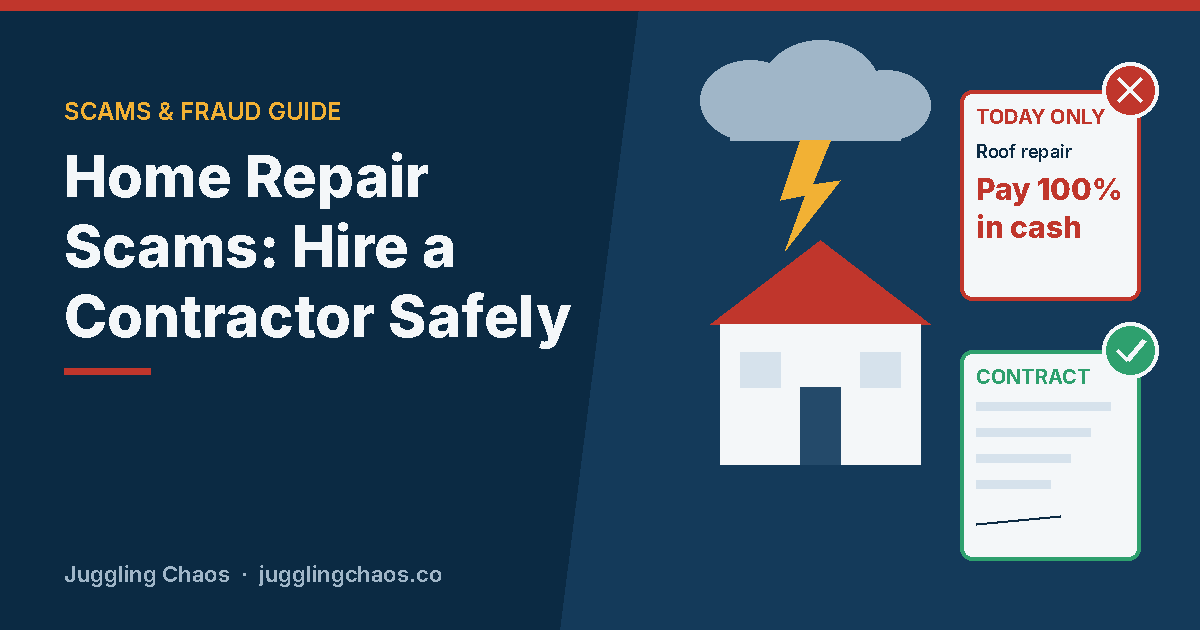
- They push you to decide now. “Today only” pricing is meant to stop you from comparing.
- They want full payment up front, or cash only. The FTC lists this as a common scam tactic.
- They ask you to get the building permits. The FTC lists this as a common scam tactic.
- They say no license is needed. The FTC warns to be wary of anyone who says this.
- They steer you to their own lender or ask you to sign something you haven’t had time to read.
- They want your insurance check. The FTC says never to sign your insurance check over to a contractor.
How to protect yourself
- Ask people you trust for referrals before you agree to anything.
- Check the license and insurance. Confirm the contractor’s license with your state or county government, and ask for proof of insurance. Hire only licensed and insured contractors.
- Look for complaints. Check with your local home builders association and consumer protection officials. Search the company’s name online with words like “scam,” “review” or “complaint.”
- Get more than one written estimate. The FTC suggests getting several. Don’t automatically pick the lowest bid, and ask why if prices are far apart.
- Get a written contract before work starts, even if your state doesn’t require one. Don’t sign anything with blank spaces.
- Pay a reasonable down payment, not the whole thing. Some states limit how much a contractor can ask for up front, so check with your state or local consumer protection office.
- Pay by credit card or check, not cash, wire transfer, gift card, payment app or cryptocurrency. Keep every invoice and receipt.
- Hold the final payment until the work is done and you’re satisfied with it.
What a good estimate and contract include
A written estimate should describe the work, the materials, the completion date and the price. Once you choose a contractor, the FTC says the contract should include:
- The contractor’s name, address, phone number and license number.
- An estimated start date and completion date.
- A payment schedule.
- Any promises made out loud about the scope of work and the cost of labor and materials.
- A written statement of your right to cancel, if it applies (see below).
Read it all before you sign, and don’t let anyone rush you. Before transferring the deed to your home to anyone, talk to a lawyer or someone you trust.
Your three-day right to cancel
The FTC’s Cooling-Off Rule gives you three days to cancel certain sales made at your home, workplace or dorm, or at a seller’s temporary location. It also applies when you invite a salesperson to give a sales presentation in your home. Here is how it works:
- The deadline. You can cancel for a full refund until midnight of the third business day after the sale. Saturdays count as business days. Sundays and federal holidays don’t.
- What the seller must give you. At the time of sale, the seller must tell you about your right to cancel and give you two copies of a cancellation form plus a dated copy of your contract or receipt with the seller’s name and address.
- How to cancel. You don’t have to give a reason. Sign and date one copy of the cancellation form and mail it to the address given, postmarked before midnight of the third business day. If you didn’t get a form, write a letter. Send it by certified mail with a return receipt, and keep a copy.
- Your refund. The seller has 10 days to refund your money, return any check you signed, and return any trade-in.
The Rule has limits. It doesn’t cover sales under $25 made at your home, or under $130 at temporary locations. It also doesn’t cover sales needed to meet an emergency, or repairs and maintenance you asked the seller to come to your home to do, though extra purchases beyond what you asked for are covered.
After a storm or disaster
- Be skeptical of anyone promising immediate cleanup or repairs.
- Talk to your insurance company yourself about what’s covered. Don’t rely on the contractor to tell you.
- Ask your bank or credit union about a Certificate of Completion, which lets the bank pay the contractor in stages after you approve each one.
- Know that FEMA never asks you to pay to apply for assistance or to get an inspection. Anyone charging a fee to help you get FEMA money is running a scam.
- Be wary of ads or websites promising “free money from the government” for home repairs. USA.gov notes these are often scams.
If it already happened
Act quickly and keep copies of everything:
- You signed at home within the last three business days: if the sale is covered by the Cooling-Off Rule, mail your cancellation now, postmarked by midnight of the third business day.
- You paid by credit or debit card: call the number on the back of the card, explain what happened, and ask for the payment to be reversed.
- You paid by payment app or wire transfer: report it to the app or wire company right away and ask for a refund.
- You paid and the contractor stopped showing up: try to settle it with the contractor first. After any phone call, send a letter by certified mail with a return receipt. If that doesn’t work, contact your state attorney general or local consumer protection office, a local Call for Action line, a dispute resolution program, or a legal services organization.
- You signed loan papers through the contractor: don’t sign anything more, and talk to a lawyer or a legal services organization about your options.
- Someone charged you to help with FEMA aid: report it to the FEMA Disaster Fraud Hotline at 866-720-5721 or StopFEMAfraud@fema.dhs.gov.
Report the scam at ReportFraud.ftc.gov or by calling 1-877-382-4357. You can find your state’s office through the USA.gov list of state consumer protection offices.
Helping an older parent with home repairs
- Agree on a simple rule: “Nobody gets hired from the front porch. We take their card and talk it over first.”
- Offer to help check the license, look up complaints and compare estimates before they sign.
- Remind them never to pay the full amount up front, never to pay in cash, and never to sign over an insurance check.
- Ask them to call you before signing any loan papers or anything involving the deed to the house.
Checklist
- The contractor’s license and insurance have been checked with the state or county.
- There are at least two or three written estimates to compare.
- A signed contract lists dates, a payment schedule and the license number, with no blank spaces.
- Payment is by credit card or check, with only a reasonable down payment.
- The final payment waits until the work is done and you’re satisfied.
FAQ
Is every contractor who knocks on my door a scammer?
No, but treat the visit as a starting point, not a deal. Take their contact information, then check their license, insurance and reviews and get other estimates.
How much should I pay up front?
The FTC advises against paying the full cost up front and suggests negotiating a reasonable down payment. Some states set a limit, so ask your state or local consumer protection office.
Does the Cooling-Off Rule cover emergency repairs?
Not usually. Sales needed to meet an emergency are not covered, and neither are repairs you invited the seller to your home to do. Extras sold beyond your request are covered.
A contractor says they can handle my insurance claim. Is that okay?
Be careful. The FTC says not to rely on a contractor to tell you what your insurance covers, and never to sign your insurance check over to them. Talk to your insurer yourself.
Related guides
- Imposter Scams: How to Spot Someone Pretending to Be an Agency or a Company You Trust
- How Scammers Tell You to Pay (FTC Video Guide)
- Refund, Settlement, and Recovery Scams
Sources
- Federal Trade Commission, “How To Avoid a Home Improvement Scam,” consumer.ftc.gov, accessed October 24, 2026.
- Federal Trade Commission, “Buyer’s Remorse: The FTC’s Cooling-Off Rule May Help,” consumer.ftc.gov, accessed October 24, 2026.
- Federal Trade Commission, “How To Avoid Scams After Weather Emergencies and Natural Disasters,” consumer.ftc.gov, accessed October 24, 2026.
- Federal Trade Commission, “Home Repair Scams,” consumer.ftc.gov, accessed October 24, 2026.
- Federal Trade Commission, “What To Do if You Were Scammed,” consumer.ftc.gov, accessed October 24, 2026.
- FEMA, “Rumor: It costs money for an inspection or to apply for assistance,” fema.gov, accessed October 24, 2026.
- USAGov, “Government home repair assistance programs,” usa.gov, accessed October 24, 2026.
- USAGov, “State consumer protection offices,” usa.gov, accessed October 24, 2026.
This is general information, not legal or financial advice. If you lost money, contact your bank or payment provider right away and report the scam at ReportFraud.ftc.gov.
Get one safety checklist a month
Juggling Chaos Monthly is free: one 15-minute checklist, one scam warning sign, and our newest guides. Sign up on the newsletter page.
Juggling Chaos will never ask for a password, payment, gift card, or verification code. Guides are general information, not legal or financial advice; see our Disclaimer and Terms and Editorial Policy.