Fake Check Scams: Overpayments, Prizes, and Why “Cleared” Isn’t Safe
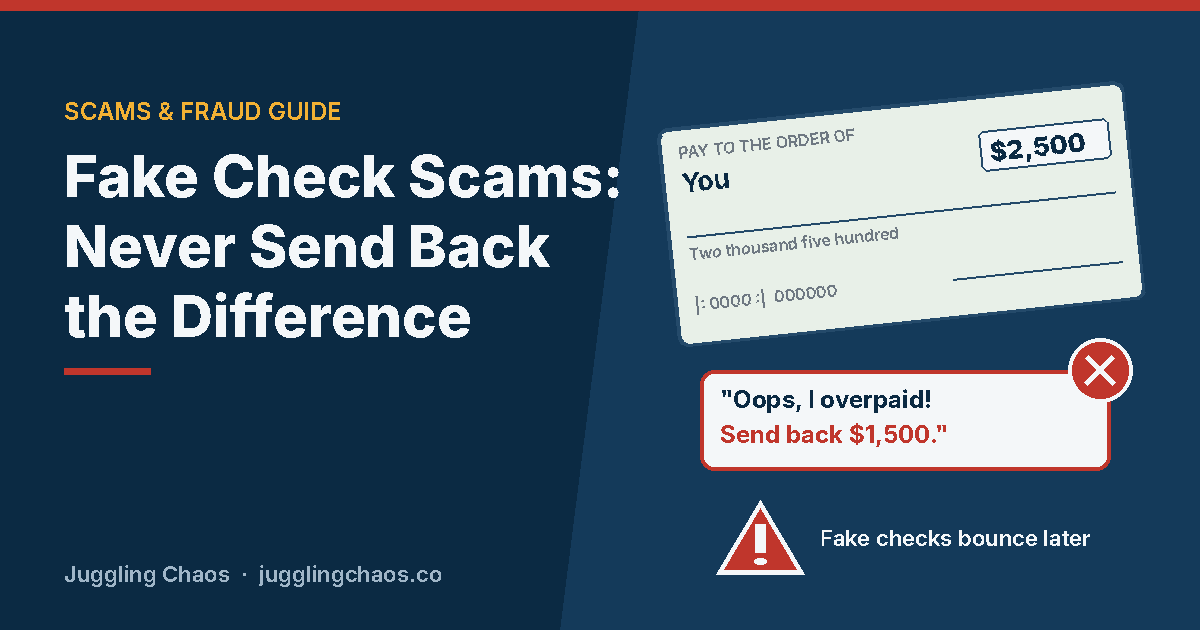
A fake check scam starts when someone you don’t know sends you a check, usually for more than they owe you, and asks you to send part of the money back or on to someone else. The check looks real. Your bank may even make the money available in a day or two. Weeks later the check bounces, the bank takes the money back out of your account, and the money you sent is gone. The same trick shows up in online sales, job offers and prize letters.
This guide is for anyone who sells things online, gets checks in the mail, or helps a parent with their mail and bank accounts. It explains how these scams work, why “the money cleared” isn’t proof of anything, and what to do if you already deposited a check that turned out to be fake. The advice below was checked against the Federal Trade Commission (FTC), the Consumer Financial Protection Bureau (CFPB) and the Office of the Comptroller of the Currency’s HelpWithMyBank.gov on October 24, 2026.
How fake check scams work
The FTC says scammers always have a good story to explain why you can’t keep all the money. The most common versions:
- The overpaying buyer. You list a car, a couch or a set of golf clubs online. A buyer who says they are out of town and can’t see the item in person sends a check for more than your price. Then they say it was a mistake and ask you to send back the difference, or pay their “shipper” out of the extra.
- The mystery shopper job. You are “hired” to test a store’s service. A check arrives with instructions to deposit it, use the money to buy gift cards or wire money as your first “assignment,” and keep the rest as pay.
- The prize or sweepstakes win. A letter says you won, and a check is enclosed to help cover the “taxes” or “fees.” You are asked to send that amount back before you get the rest of your prize.
In every version, the money you send is real and the check is not. By the time the bank finds out, the scammer has your money.
Warning signs
- The check is for more than you are owed. The FTC’s advice is simple: don’t accept a check for more than the selling price.
- You are asked to send money back. Any request to return part of a check, or pass it along to someone else, is the heart of this scam.
- They want gift cards, a wire transfer, a money order or cryptocurrency. These payments are hard to trace and hard to get back once sent.
- You have to pay to get a prize. The FTC says real prizes are free. Fees for “taxes,” “processing” or “shipping” mean it’s a scam.
- A job pays you before you have done any work, or asks you to pay a fee to start. The FTC says paying an upfront fee to become a mystery shopper is always a scam.
- The buyer can’t meet, can’t talk on the phone, and is in a hurry. Pressure to act before your bank can check the payment is a red flag.
How to protect yourself
- Never send money back from a check. The FTC says never to use money from a check to buy gift cards, send money orders or cryptocurrency, or wire money to anyone who asks you to.
- Don’t accept overpayments. If a buyer sends too much, return the whole check and ask for the correct amount another way, or simply end the sale.
- Don’t rely on money from a check unless you know and trust the person who gave it to you. That is the FTC’s “best bet” advice.
- Talk to your bank before you act on a check from someone you don’t know. If you want to confirm a check with the bank it is drawn on, look up that bank’s phone number yourself instead of using a number printed on the check.
- Talk to someone you trust, and search a company’s name with words like “review,” “complaint” or “scam” before you agree to a job or prize.
Why “the money cleared” doesn’t mean the check is good
When you deposit a check, federal rules require banks to make the money available fairly quickly. The CFPB explains that many deposits, including cashier’s and government checks deposited in person, must be available by the next business day, and that larger checks are generally available within days. Your bank can hold funds longer in some cases, such as a new account or a check it suspects is fraudulent.
But “available” only means you can spend it. It does not mean the check was paid by the bank it was written on. The FTC warns that even if you see the funds in your account, that doesn’t mean it’s a good check, and that it can take weeks for a bank to figure out a check is fake. HelpWithMyBank.gov adds that if a deposited check turns out to be fraudulent, your bank can reverse the credit or ask you to repay it, and may charge an overdraft fee if your balance goes below zero.
In plain terms: the person who deposits the check is the one left owing the bank. Fake checks often carry real bank names, so a convincing look proves nothing.
Safer ways to get paid when you sell things
Most buyers are honest. A few habits keep the dishonest ones from costing you anything:
- Ask for the exact price, and nothing more. There is no honest reason for a buyer to send extra money for you to pass along.
- For larger sales, consider an escrow or online payment service. The FTC suggests this for people selling a car online. Choose and look up the service yourself rather than using one the buyer suggests.
- Prefer local buyers you can meet. If someone can’t see the item, can’t talk by phone and wants to send a check by courier, treat that as a reason to walk away.
- Don’t hand over the item until your bank confirms the money is truly yours, not just showing in your balance. If you aren’t sure, ask the bank directly.
If you already deposited a fake check
Act quickly, and work through what applies:
- You deposited the check but haven’t sent any money: call your bank, tell them you think the check is fake, and don’t spend or send any of it.
- You sent money by wire transfer: contact the wire company right away, tell them it was a fraudulent transfer, and ask them to reverse it. The FTC lists MoneyGram at 1-800-666-3947 and Western Union at 1-800-325-6000.
- You bought gift cards and shared the numbers: contact the company that issued the card as soon as you can. The FTC notes gift card companies may be able to refund you if you act quickly.
- You sent money by bank transfer or a debit or credit card: call your bank or card company, report it as fraud, and ask them to reverse the transaction.
- You mailed cash: contact the U.S. Postal Inspection Service at 877-876-2455 and ask whether they can intercept the package.
- You shared your bank account or Social Security number: go to IdentityTheft.gov for a recovery plan and consider a credit freeze.
Report the scam to the FTC at ReportFraud.ftc.gov. If the check came by mail, you can also report it to the U.S. Postal Inspection Service, and you can contact your state attorney general. Be wary of anyone who later offers to get your money back for a fee.
Helping an older parent with fake check scams
- Share one simple rule: “If someone sends us a check and asks for money back, it’s a scam. Every time.”
- Offer to be the person they call before depositing any check from a stranger, a prize company or a new “employer.”
- If they sell things online, help them write listings that say “exact price only, local pickup” and set up a payment method you both understand.
- If they have already lost money, keep the tone kind. The FTC notes people are often embarrassed to talk about these scams, and blame makes them less likely to tell you next time.
Checklist
- Nobody in the family sends money back from a check they received.
- Overpayments are refused, not refunded.
- Checks from strangers get a call to the bank before anything else happens.
- Online sales use the exact price and a payment method you trust.
- ReportFraud.ftc.gov and your bank’s fraud number are saved.
FAQ
The bank let me withdraw the money. Doesn’t that mean the check is real?
No. Banks must make deposited money available quickly, but it can take weeks to learn a check is fake. When that happens, the bank can take the money back out of your account.
Is a cashier’s check always safe?
Not always. Scammers fake cashier’s checks too. If a cashier’s check comes from someone you don’t know, ask your own bank to help you confirm it before you rely on the money, and never send any of it back.
Do real mystery shopping jobs exist?
Yes. Some stores and restaurants pay people to try their service and report back. The FTC says real mystery shopping is usually part-time or occasional work, real jobs don’t charge you to start, and no real job will have you deposit a check and buy gift cards with it.
I won a lottery in another country and they sent a check for the fees. Should I deposit it?
No. The FTC says offers involving foreign lotteries are almost always scams and that it is illegal for U.S. citizens to play a foreign lottery. Don’t deposit the check, and report it to the FTC.
Related guides
- Gift Cards Are Only for Gifts
- Job Scams: How to Spot a Fake Job Offer Before You Pay
- How Scammers Tell You to Pay (FTC Video Guide)
Sources
- Federal Trade Commission, “How To Spot, Avoid, and Report Fake Check Scams,” consumer.ftc.gov, accessed October 24, 2026.
- Federal Trade Commission, “Fake check scam targets online car sellers,” consumer.ftc.gov, accessed October 24, 2026.
- Federal Trade Commission, “Anatomy of a fake check scam,” consumer.ftc.gov, accessed October 24, 2026.
- Federal Trade Commission, “Fake Check Scams” infographic, consumer.ftc.gov, accessed October 24, 2026.
- Federal Trade Commission, “Mystery Shopping Scams,” consumer.ftc.gov, accessed October 24, 2026.
- Federal Trade Commission, “Mystery shopping, (fake) checks, and gift cards,” consumer.ftc.gov, accessed October 24, 2026.
- Federal Trade Commission, “Fake Prize, Sweepstakes, and Lottery Scams,” consumer.ftc.gov, accessed October 24, 2026.
- Federal Trade Commission, “Paid someone you think is a scammer?,” consumer.ftc.gov, accessed October 24, 2026.
- Consumer Financial Protection Bureau, “How long can a bank or credit union hold funds I deposited?,” consumerfinance.gov, accessed October 24, 2026.
- Office of the Comptroller of the Currency, “Aren’t cashier’s checks supposed to be honored immediately?,” helpwithmybank.gov, accessed October 24, 2026.
This is general information, not legal or financial advice. If you lost money, contact your bank or payment provider right away and report the scam at ReportFraud.ftc.gov.
Get one safety checklist a month
Juggling Chaos Monthly is free: one 15-minute checklist, one scam warning sign, and our newest guides. Sign up on the newsletter page.
Juggling Chaos will never ask for a password, payment, gift card, or verification code. Guides are general information, not legal or financial advice; see our Disclaimer and Terms and Editorial Policy.