
Student Loan Scam Signs: 9 Red Flags to Spot Fast
The clearest student loan scam signs are a fee for help, a promise of fast or total forgiveness, a request for your StudentAid.gov password, and pressure to act today. If a call, text, email or ad does any of these, stop. Do not pay, do not share anything, and check with your loan servicer directly.
Scammers follow the news. When forgiveness or repayment plans make headlines, offers show up in your inbox, your texts and your social feeds. This guide shows you what those offers look like, how to check one in a few minutes, and what to do if you already responded.
TL;DR
- Real federal help with your loans is free. Anyone charging an upfront or monthly fee is a red flag.
- No one can promise immediate, total forgiveness. The Department of Education and its partners will never ask for your password.
- Official-looking names, seals, logos and “limited enrollment” deadlines prove nothing.
- If you already paid or shared information, call your bank, call your loan servicer, and report it to the FTC at ReportFraud.ftc.gov.
- The same tactics show up in Medicare and other loan scams, so the checks below work beyond student loans.
Table of Contents
- The 9 signs of a student loan scam
- Quick reference: scam versus the real thing
- What a scam looks like in real life
- How to check an offer in five minutes
- What to do if you already paid or shared information
- Are these scams still active?
- Scholarship and school-time scams
- Perspective: why these scams work on smart people
- Medicare scam warning signs
- Get more help from us
- FAQ
- Sources
The 9 signs of a student loan scam
You do not need all nine. One is enough to pause.
1. They want money before they help
This is the most common sign. The Consumer Financial Protection Bureau says companies that ask for payment before they provide debt relief are breaking the law, and that you can manage many loan services yourself for free. The FTC puts it the same way: it is illegal for companies to charge you before they help you reduce or get rid of your student loan debt.
A monthly “membership” or “processing fee” counts too. If the first conversation ends with a payment request, walk away.
2. They promise immediate or total forgiveness
Federal Student Aid lists promises of immediate and total loan forgiveness or cancellation as a mark of a scam. Real programs have eligibility rules and applications handled through your servicer or StudentAid.gov. Nobody can get you into a program you do not qualify for.
3. They ask for your StudentAid.gov username and password
The Department of Education and its partners will never ask for your password. Anyone with your login can change your contact details, redirect your mail and lock you out. Treat your FSA ID like a bank password.
4. They create a deadline
Aggressive ads that urge you to act right now, cite “new laws” or claim limited enrollment are not from the Department of Education or its partners. Real programs do not vanish if you take a day to check. Urgency is the tool that stops you from checking.
5. The name, seal or logo looks official
Scammers pick names with words like “federal,” “national” or “student aid,” and borrow seals and logos. The FTC warns that government-looking seals and logos are not proof of anything. The same goes for a professional website or a polished email signature.
6. The email address does not match
Check the sender address letter by letter. Federal Student Aid tells borrowers to compare an email against the Department of Education’s listed addresses. A lookalike domain, a free webmail address or a random string of numbers is a bad sign.
7. They ask you to sign a power of attorney or third-party authorization
Some scammers demand a signed third-party authorization or power of attorney. According to Federal Student Aid, this gives them legal authority to talk to your servicer and can cut you off from real information about your loans. The CFPB also reported borrowers being asked to sign a power of attorney so a company could deal with their servicer and make financial decisions for them.
You never need to hand that over to get free federal help.
8. They contacted you first about a loan you never asked about
The FTC says unexpected calls about loans you did not apply for may be fishing for your Social Security or bank account number. Do not call back the number that appeared, and do not trust the caller ID. Scammers can make any name or number show up on your screen.
9. They promise a loan no matter your credit
This one targets people who need new money for school. In an advance-fee loan scam, the lender guarantees a loan regardless of your credit history and then demands a “processing,” “insurance” or “application” fee before the loan arrives. The loan never does.
Quick reference: scam versus the real thing
| Situation | Scam pattern | What legitimate help looks like |
|---|---|---|
| Cost | Upfront or monthly fee | Free through StudentAid.gov and your servicer |
| Forgiveness | Guaranteed, instant, total | Rules, eligibility and an application |
| Login | Asks for your FSA ID and password | Never asks for your password |
| Timing | “Act today, limited spots” | No pressure to decide on the spot |
| Contact | Unsolicited call, text or ad | You contact your servicer using a number you looked up |
| Paperwork | Power of attorney or third-party authorization | You keep control of your own account |
What a scam looks like in real life
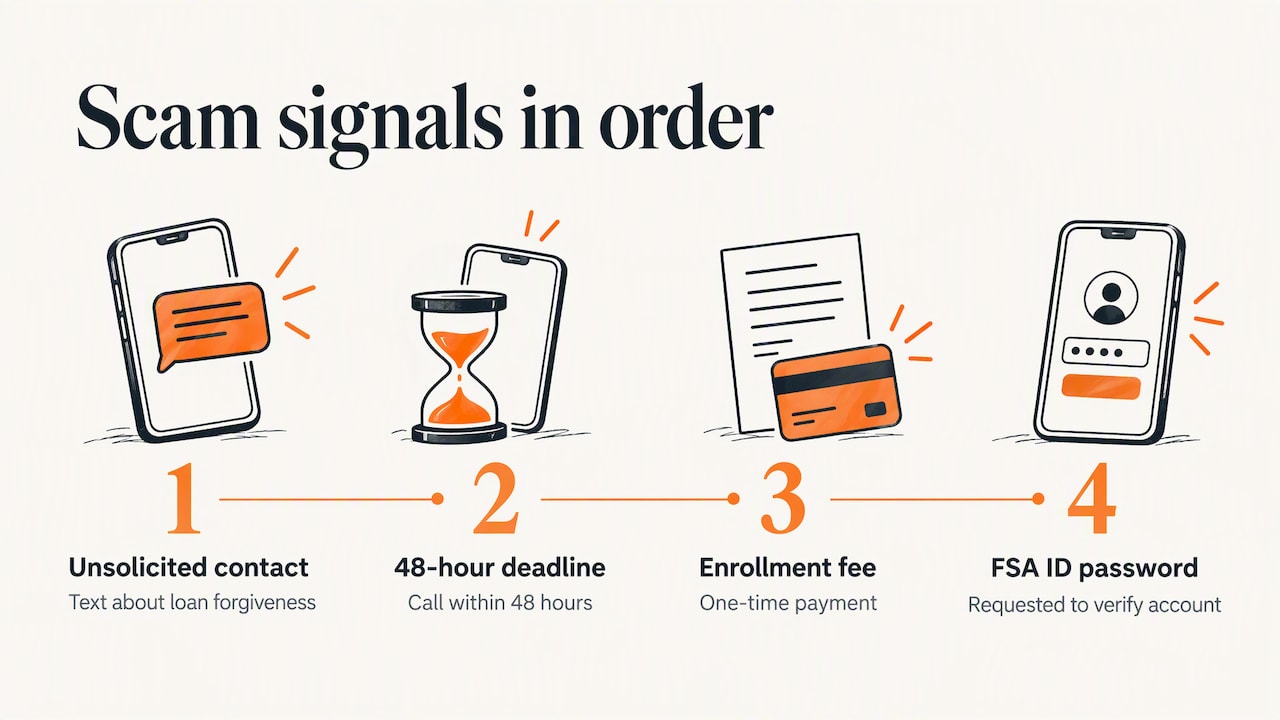
Here is a typical pattern, described generally, not a specific case. A text says your loans qualify for a “new forgiveness program” and you must call within 48 hours. The person who answers sounds friendly and already knows you have federal loans. They say there is a one-time enrollment fee, then ask for your FSA ID “to verify your account.”
That one conversation hits four signs: a deadline, a fee, a password request and an unsolicited contact. Each alone is a reason to hang up.
The quieter version is a company that charges a monthly fee to “handle” paperwork you could do yourself for free. It may not feel like a scam, but the fee for help is exactly what the rules aim to stop.
How to check an offer in five minutes
- Do not reply to the message. Not even to say no or to unsubscribe.
- Log in on your own. Type StudentAid.gov into your browser. Do not use a link from the message. Your account dashboard shows your loans, your servicer and the programs you may be eligible for.
- Call your servicer using the number on your statement or on StudentAid.gov. Ask whether the offer is real.
- Contact the Federal Student Aid Information Center to confirm an offer. Federal Student Aid recommends this step if you are unsure.
- Still unsure? Run it through our free two-minute scam check.
If your loans are private, go straight to your loan servicer, since federal programs do not apply to them.
What to do if you already paid or shared information
Do these in order, today.
- Call your bank or credit card company. Ask them to stop or dispute the payment, and freeze payments to that company.
- Call your federal loan servicer. Tell them what happened so they can protect your account. If you gave out your FSA ID, change it right away.
- Report it to the FTC at ReportFraud.ftc.gov. Federal Student Aid lists these same three steps.
- Watch for follow-up. People who have been scammed once are often contacted again, sometimes by someone offering to “recover” the money for a fee. That is a second scam. Our guide to refund and recovery scams explains why.
If you shared your Social Security number, consider a credit freeze. It is free and stops new accounts from being opened in your name.
More on the fee rules and free options is in our guide to debt relief scams.
Are these scams still active?
Yes. The FTC’s education page lists recent student loan debt relief enforcement actions, including actions in 2026, and notes that in July 2026 the agency announced a proposed order to permanently ban a student loan debt relief operator from the debt relief industry and telemarketing. Check that page for the latest cases.
The scammers change their wording to match the headlines: forgiveness, payment pauses, new repayment plans. The signs stay the same.
Scholarship and school-time scams
Student loan scams are not limited to people already repaying. Students and parents also meet fake loan offers, “guaranteed” scholarships and paid financial aid help. The rule is the same: free federal forms and free federal help do not cost money. Our page on student loan and scholarship scams covers these cases step by step.
Perspective: why these scams work on smart people
We do not think people fall for these because they are careless. They fall because the timing is perfect. A borrower is worried about a bill, the message arrives right after a news story, and the caller sounds calm and helpful.
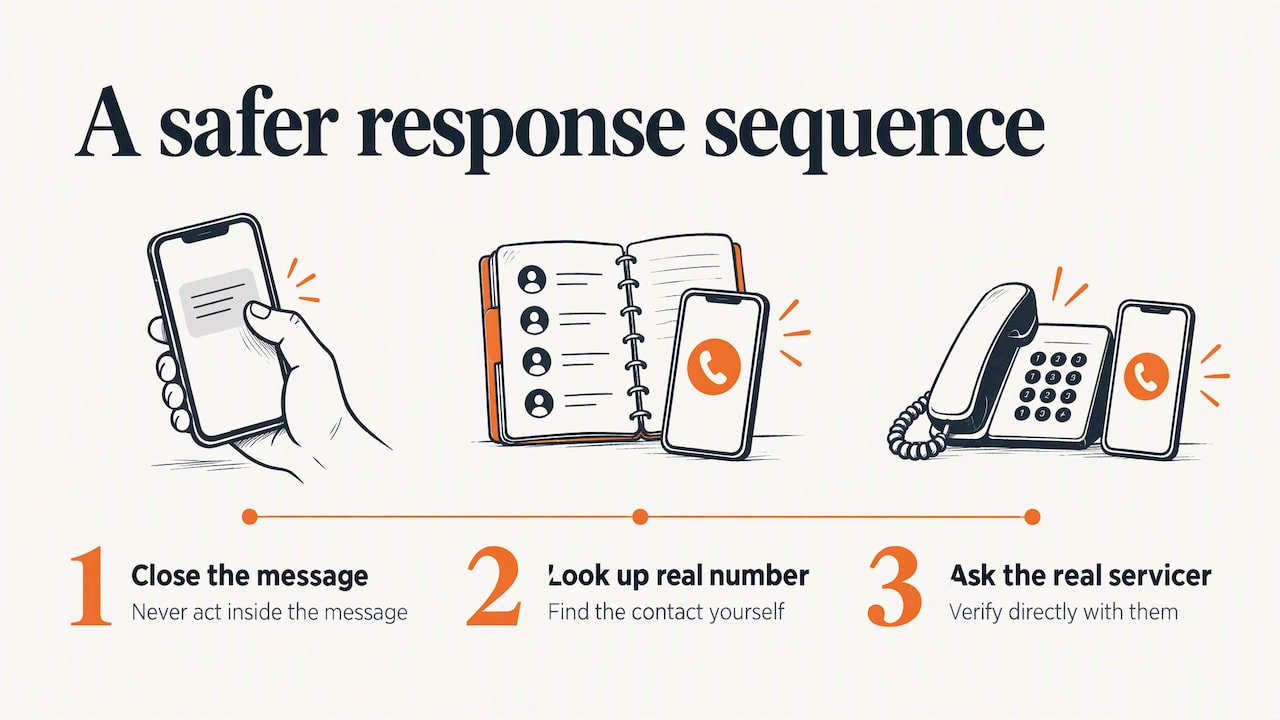
So we do not tell readers to “just be more careful.” We give one habit that works under stress: never act inside the message. Close it, look up the real number yourself, and ask the real servicer. It takes five minutes and defeats nearly every version of this scam.
We also tell families to talk about it. Parents often co-sign or help with loans, and grandparents sometimes pay for school. Everyone who touches the loan should know that real help is free and no one needs a password.
— Robert
Medicare scam warning signs
Many readers searching for loan scam signs are also checking on a parent’s Medicare coverage, and the tactics overlap. The National Council on Aging lists five warning signs of a Medicare scam:
- Offers of free medical equipment, prescriptions or screenings in exchange for your Medicare number
- Pressure to switch plans, or claims you must pay a fee to enroll
- Calls saying you must activate, renew or upgrade your card
- Threats that you will lose coverage unless you verify information now
- Claims that you are owed a “refund” and need to give your Medicare or bank number
The pattern matches student loans: a fee, a deadline, a request for sensitive numbers. For older relatives, our tech safety plan for older parents helps set up simple rules before a call comes in.
Get more help from us
If you want one place to start, we built a set of free guides for people who are not tech experts. They cover the scams families see most, in plain language, with steps you can follow.
Our Free Family Safety Checkup walks you through 20 steps for your accounts, phones and family habits. You can also browse every scam type in Scam A to Z or print the free scam and safety guides for a parent or a student heading off to college.
If a message feels wrong but you are not sure why, our guide to warning signs of a scam shows the common patterns in a short video format.
FAQ
Is there a student loan scam going around right now?
Yes. The FTC’s education page lists recent student loan debt relief enforcement actions, including actions in 2026. Scammers adapt their pitch to whatever is in the news. If you get an unexpected message about forgiveness, treat it as a scam until your servicer confirms otherwise.
How can I tell if a student loan forgiveness offer is real?
Log in to StudentAid.gov yourself and see which programs apply to you. The Department of Education and its partners do not charge for forgiveness programs or ask for your password. If you are unsure, call your servicer or the Federal Student Aid Information Center.
What are the signs of a loan scammer?
The FTC points to promises of credit no matter your credit history, a demand for an upfront fee before you get the loan, and unsolicited calls or ads offering loans. A legitimate lender does not need payment before delivering a loan.
Can I pay someone to help with my student loans?
You do not have to. The CFPB says you can manage many loan services yourself for free, and companies that charge before helping with debt relief are breaking the law. Start with your servicer and StudentAid.gov.
What should I do if I gave a scammer my password?
Change your FSA ID right away and call your federal loan servicer. Then contact your bank if money was involved, and report the scam to the FTC at ReportFraud.ftc.gov. Those steps follow Federal Student Aid’s guidance.
Sources
- How To Avoid Student Loan Forgiveness Scams, Federal Student Aid
- Avoiding Student Aid Scams, Federal Student Aid
- What are the signs of a student loan scam? CFPB
- Consumer advisory on student loan forgiveness scams, CFPB
- Scammers follow the news about student loan forgiveness, FTC
- What To Know About Advance-Fee Loans, FTC
- Ignore unexpected calls about loans you didn’t apply for, FTC
- A Fraud Handbook for Recent Refugees and Immigrants, FTC
- Education, Federal Trade Commission
- 5 Warning Signs of a Medicare Scam, National Council on Aging