Life Insurance Scams: How to Spot Them and What to Do
Life insurance itself is not a scam. The scams are the fake agents, fake policies, phishing messages and phone calls built around it. The pattern is almost always the same: someone you did not seek out asks for money or personal information, and the policy they describe cannot be confirmed with a real insurer. This guide shows you what the common scams look like, how to check any agent or policy in about ten minutes, and what to do if you already paid or shared details.
TL;DR
- Life insurance is a legitimate product. Scams use its name: fake agents, account takeover and premium diversion are the most common patterns.
- Red flags: an agent who is not licensed, a policy the insurer cannot confirm, a request to pay the agent directly, and pressure for personal details.
- Verify the policy with the insurer using contact details you find yourself, then confirm the agent and company are licensed in your state.
- If you suspect fraud, contact your state insurance department and report it. Move fast if you shared a Social Security number or bank details.
Table of Contents
- Is life insurance a scam?
- How life insurance scams work
- Warning signs of a life insurance scam
- How to verify an agent, a company and a policy
- Mis-selling: the legal pitch that still costs you
- What to do if you think you were scammed
- Are timeshares scams too?
- Our perspective
- Make this part of your family’s routine
- FAQ
- Sources
Is life insurance a scam?
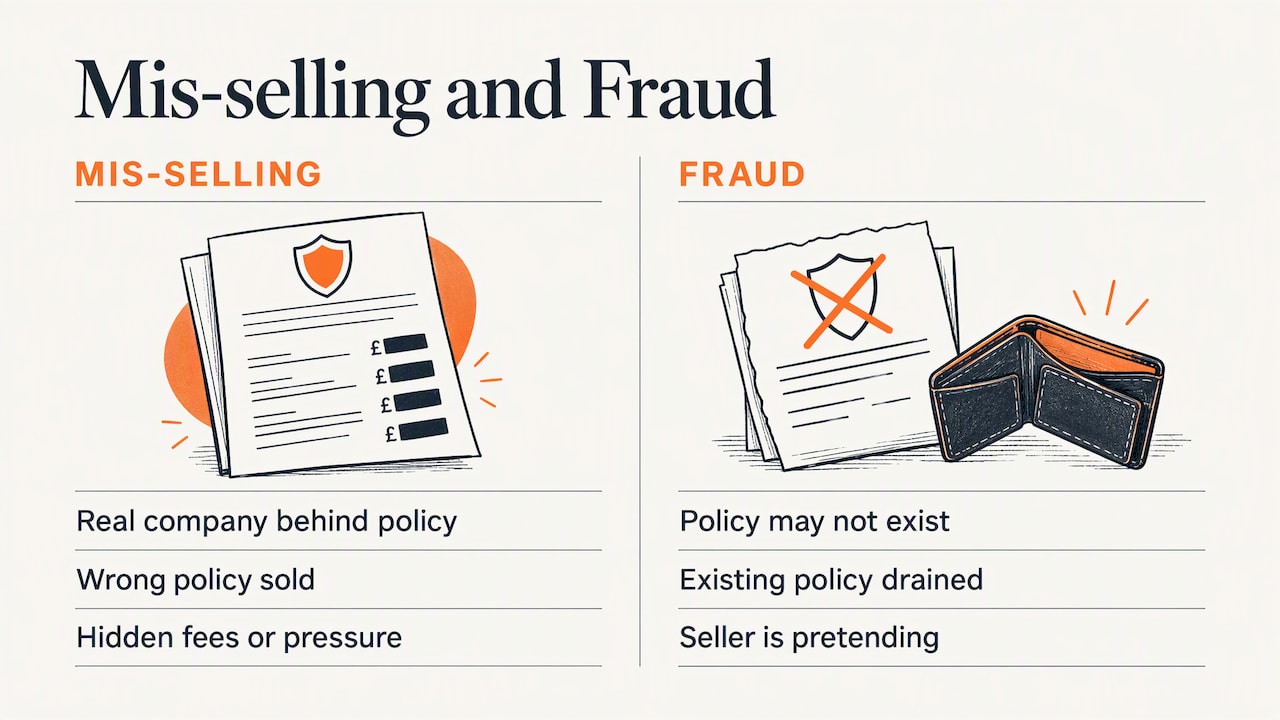
No. Life insurance is a regulated product that pays your beneficiaries when you die. When people say it is a scam, they usually mean one of two things: they were sold the wrong policy, or they were targeted by someone pretending to sell one.
The first is mis-selling. Aggressive sales tactics, misleading marketing, hidden fees or dishonest practices are the signs that a pitch has gone wrong, even when the company behind it is real. A pushy agent who hurries you past the costs is a reason to walk away, not proof that all life insurance is bad.
The second is outright fraud: the policy does not exist, or someone is draining a policy that does. This guide covers that second kind, with a section on mis-selling so you can tell the difference.
How life insurance scams work
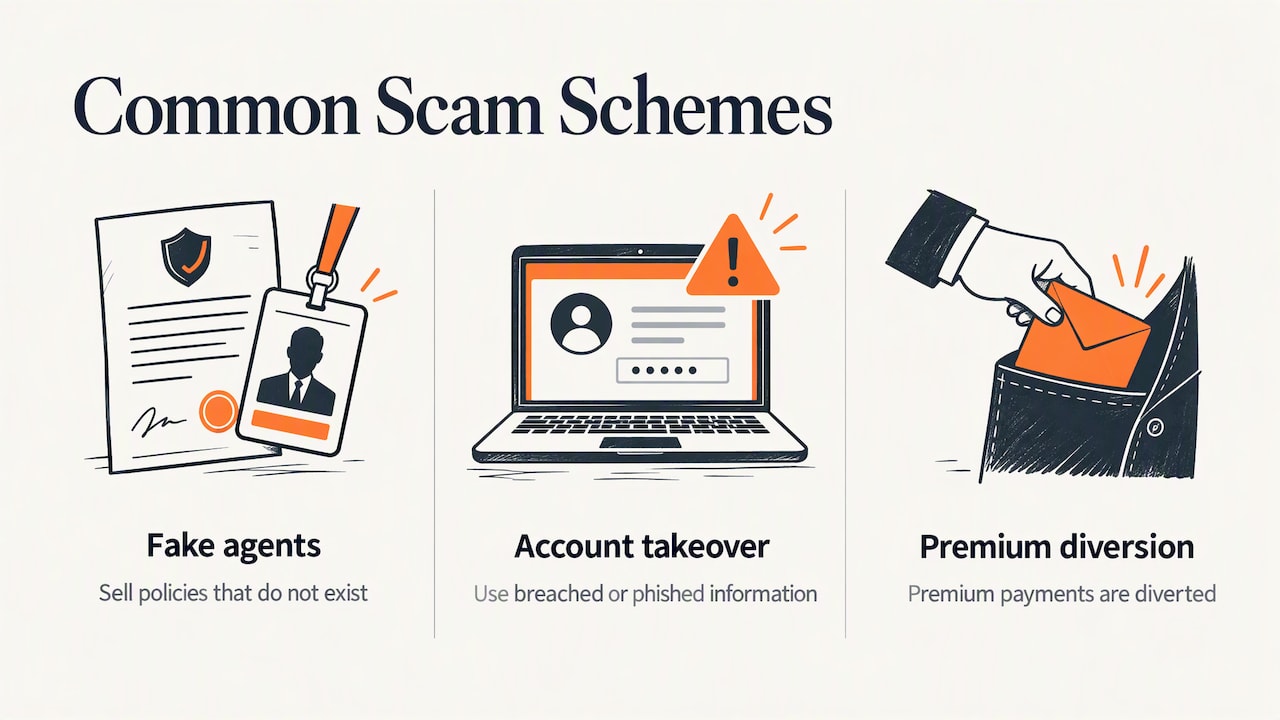
The National Insurance Crime Bureau lists several schemes. Three come up most often: fake agents selling policies that do not exist, account takeover using information from data breaches or phishing, and premium diversion. Here is how each plays out in real life.
Fake agents and fake policies
Someone calls, texts or messages you offering cheap or even free coverage. They may say it is a final expense plan, a plan for your spouse, or a “last chance” rate. You pay a first premium. A document arrives, sometimes looking very professional. The policy was never issued. When a family member files a claim years later, there is no insurer on the other end.
The damage is not only the money. Your family believes they are protected, and you may have skipped buying real coverage while you were healthy and could qualify.
Account takeover
Criminals who already have your personal details, often from a data breach or a phishing message, contact your insurer pretending to be you. They may change the address, the bank account or the beneficiary, or take out a loan against the policy’s cash value. You find out when a payment fails or a claim goes wrong.
If your information has been exposed somewhere, read our guide to identity theft recovery steps. Insurance accounts are one more place a thief can use your identity.
Premium diversion
You pay a person, not the insurer. The person keeps the money, and the policy lapses or never starts. This is why the warning signs below include any request to pay premiums directly to an agent. Real premiums go to the insurance company through its own payment system.
The phone call that pretends to be your insurer
One widely shared case involved a widow who received a call about an “unpaid” policy after her husband died. The caller demanded payment by gift card. Grieving families are targeted on purpose: the scammer expects a stressed person to pay quickly rather than check. If a caller says a policy is overdue, hang up and look up the insurer’s number on your statement or on its website.
Scams aimed at older adults
Final expense and burial policies are often marketed to seniors, which makes them a favorite cover story. Scammers may pose as a legitimate source and ask you or your beneficiaries for account access or sensitive details. Our guides on IRS and Social Security imposter scams and Medicare fraud show the same script in other costumes: a call you did not expect, a deadline, and a request for numbers or money.
Warning signs of a life insurance scam
These are the signs the National Insurance Crime Bureau points to. An agent who is not licensed or authorized, a policy that cannot be confirmed with the insurer, requests to pay premiums directly to the agent, and requests for personal information all mean stop.
Add these common-sense checks:
- You did not ask for the contact. An unexpected call, text or email about coverage is a prompt to slow down.
- There is a deadline. “Today only” or “your rate expires tonight” is a sales tactic at best and a scam at worst.
- Payment is unusual. Gift cards, wire transfers, cash apps or cryptocurrency are never how a real insurer collects a premium.
- No paperwork you can check. You cannot find the company, the license number, or the policy number in any independent source.
- Too good to be true. Free coverage with no health questions and huge payouts does not exist for most people.
- They want the whole Social Security number or bank login early. A quote does not need either.
If you want a quick gut check on a message or call, try our free two-minute scam check. For the general patterns, our video guide on the warning signs of a scam is a good starting point.
How to verify an agent, a company and a policy
Do these before you pay anything, or right now if you already have a policy you are unsure about.
- Do not use the contact details the person gave you. A fake agent will supply a fake phone number and a convincing website.
- Find the insurer yourself. Search for the company name, or use the number printed on an official statement. Verify the policy directly with the insurer using contact information you found independently.
- Ask for the policy number and confirm it. The insurer should be able to tell you whether the policy exists, who the owner is, and who the beneficiaries are. If they cannot find it, treat that as a serious problem.
- Check licensing. Confirm that both the insurer and the agent are currently licensed in your state through your state insurance department. Most departments have a license lookup on their site. Look for the agent’s full name and license number.
- Pay the insurer, not the person. Use the insurer’s official payment portal or a check made out to the company.
- Keep records. Save every email, application, receipt and policy document in one folder.
Then make this a yearly habit. Once a year, log in to each life insurance account (or call) and confirm the address, bank account and beneficiaries are what you set. It takes ten minutes and catches account takeover early.
Mis-selling: the legal pitch that still costs you
Not every bad outcome is a scam in the legal sense. Some policies are sold by licensed agents in ways that leave the buyer worse off. Watch for:
- A pitch that hides or skips the cost. Ask for the annual premium in dollars, what is guaranteed, and what can change.
- Pressure to replace a policy you already have. Replacing coverage can reset waiting periods and raise your price.
- Complicated products sold as “investments” with fees you do not understand. Our guide on how to spot and dispute hidden fees explains what to ask for in writing.
- Anyone who tells you to leave health problems off an application. That can give the insurer a reason to deny a claim later, and it is a form of application fraud.
A good agent will answer questions plainly, give you time, and put everything in writing. If you feel rushed, you can say no and shop elsewhere.
What to do if you think you were scammed
Act in this order.
- Stop paying. Cancel any recurring payment through your bank or card issuer. If you paid by card, call the card company and dispute the charge.
- Contact the real insurer. If a real company is involved, tell it about the contact and ask it to flag your account.
- Contact your state insurance department. If you suspect insurance fraud, your state or territorial insurance department may investigate or coordinate an investigation, as state law allows. It is also the right place to confirm whether an agent holds a license.
- Protect your identity. If you gave out a Social Security number, bank details or logins, follow the steps in our identity theft recovery guide. Changing passwords on email and financial accounts comes first.
- Watch your phone number. Scammers who have your details sometimes try to take over your number too. See our guide on SIM swap scams.
- Report it. Your report helps others, and our video guide explains why reporting fraud matters.
For more on the wider picture, our financial fraud overview covers other types and the signs that come with them.
Are timeshares scams too?
People often search for life insurance scams and timeshare scams in the same session, because both involve big promises and large payments. A timeshare is not a scam by definition. The scams cluster around getting out of one.
The Federal Trade Commission warns that resale or exit companies may promise a quick sale or exit, demand an upfront fee, and then do little or nothing. The same pattern shows up in life insurance fraud: pay first, results later, and the results never come.
To protect yourself, the FTC advises that you contact your timeshare company directly, research any exit company for scam or complaint reports, and be wary of large upfront fees. If you are targeted, you can report it to the FTC at ReportFraud.ftc.gov.
Our perspective
We get a lot of mail from readers who feel foolish after a scam. They should not. These schemes work because they are built around moments when people are stressed: a spouse has died, a parent is aging, a family is trying to cover funeral costs. A scammer who sounds kind is still a scammer.
We also think the “life insurance is a scam” line does real harm. Families who walk away from coverage because of a bad story can end up with nothing when it matters. The better lesson is narrower: you choose the agent, you find the insurer’s number, and you never pay a person when you should be paying a company.
One habit covers most of this. Whenever someone you did not contact asks for money or numbers, stop, hang up, and look up the organization yourself. It feels rude. It is also the most effective step in this guide. Teach it to parents, teens and grandparents alike, and keep a short list of verified numbers (your insurer, your bank, your doctor) where everyone can find it.
— Robert
Make this part of your family’s routine
Life insurance is one of several places where a family can be targeted. Our Free Family Safety Checkup walks you through 20 steps covering accounts, phones, passwords and scam habits, so everyone in the house knows what to do when a strange call comes in.
If you want something to put on the fridge, our free printable scam and safety guides are made for exactly that. You can also browse the Scam A to Z list when a message does not fit any category you know.
FAQ
How do I know if a life insurance offer is real?
Find the insurer on your own, not through the link or number you were given, and ask whether the agent and policy exist. Then check the agent’s and company’s license with your state insurance department. If either step fails, do not pay.
Can a scammer change the beneficiary on my policy?
It is possible if they have enough of your personal information to pass as you, which is how account takeover works. Review your beneficiaries once a year and call the insurer if anything looks different. If your data has been exposed, follow our identity theft recovery steps and tell the insurer.
What should I do if someone calls saying my policy is unpaid?
Hang up. Look up the insurer’s number on a statement or on its official website and call that number to ask about the account. Do not pay by gift card, wire or cash app, and do not give out your Social Security number to a caller who contacted you first.
Is it worth getting life insurance?
For many families with dependents, it can be, because it replaces income or covers debts and final costs if you die. The key is buying from a licensed agent or directly from a real insurer, comparing costs in writing, and avoiding anyone who pressures you. A licensed professional can help you decide how much coverage fits your situation.
Are timeshares scams?
Timeshares are legal, but timeshare exit and resale scams are common. Be cautious of any company that wants a large upfront fee and promises a fast exit. Start by contacting your timeshare company directly, and report scams to the FTC.
Sources
- Life Insurance Fraud: Common Scams to Watch For (NICB)
- Is Life Insurance a Scam? (Money)
- Need help with insurance? Insurance departments are your trusted source (NAIC)
- Timeshares, Vacation Clubs, and Related Scams (FTC Consumer Advice)